September 28, 2026
Online classes are working when your child is more engaged, more skilled and more independent than a few weeks ago. Here is what to look for at 4, 8 and 12 weeks.


No worksheets. No arguments. Just ten questions that quietly build a child’s feel for numbers.
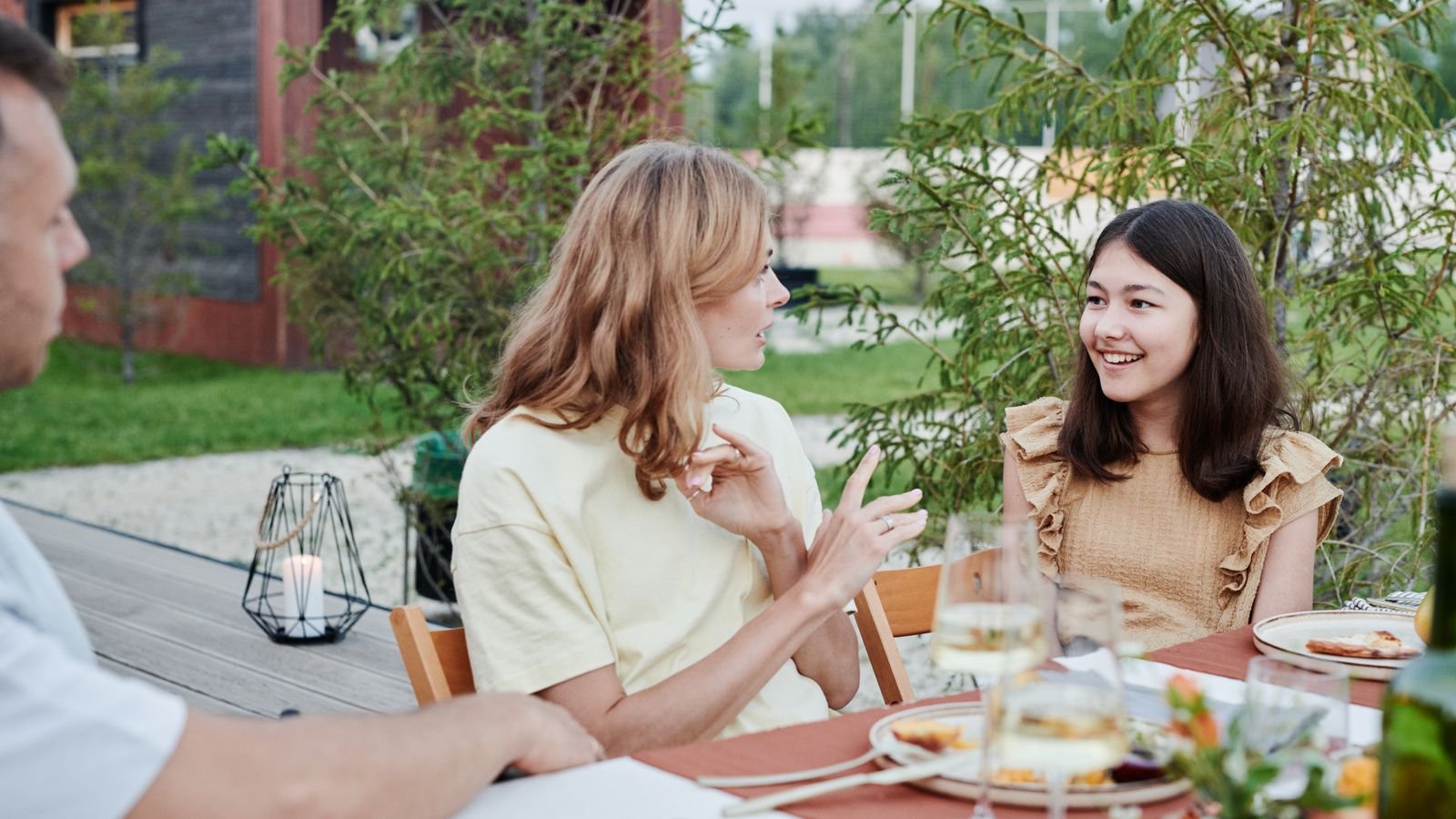
Most parents who want to help with maths reach for a workbook, and most of those workbooks end in a stand off by week three. There is a quieter approach that research supports and that costs nothing: talk about numbers during things you are doing anyway. Dinner happens every night, everyone is sitting still, and nobody has to be persuaded to attend.
This article gives you ten questions to use, how to ask them so your child actually engages, and how to adjust them as your child grows.
Casual conversation about numbers is linked to stronger maths skills in children, and researchers have measured it directly. A body of work reviewed across 22 studies found that the more parents talked about numbers and shapes with their children, the stronger those children’s maths skills were, with the strongest link appearing between ages three and five.
What counts as maths talk is far more ordinary than parents expect. In those studies, researchers tracked how often parents mentioned numbers or shapes at all, and everyday sentences that happened to include a number were counted. Asking a child to hand you three of something is, technically, maths talk.
There are two caveats worth being honest about. Much of this research is correlational, so it shows a link rather than proving cause, and the observation windows were often short and sometimes recorded in labs rather than kitchens. But the practical advice that falls out of it is harmless, free and easy: talk about numbers more often, and get your child talking about them too.
Dinner is the ideal slot because it is repeatable. Anything you do 300 times a year beats anything you do brilliantly for one weekend.
Each of these questions is designed to be asked in under ten seconds and answered without paper. Use one per meal, not all ten, and let the conversation move on afterwards.
Division and fractions, hidden inside something your child cares about. Six samosas and four people gives you a remainder to argue over, which is where the real thinking happens.
Estimation is a badly neglected skill. Children are taught to calculate exactly and rarely taught to approximate, yet approximation is what adults use all day. Accept any sensible guess and reveal the real figure.
Working backwards through time is genuinely hard for children and enormously useful. It is subtraction with an awkward base, and it maps onto real consequences they understand.
Comparing fractions is one of the most common stumbling blocks in primary maths, and the food on the plate makes it concrete. Many children assume a quarter is bigger because four is bigger than three.
Proportional reasoning, which underpins ratios, percentages and later algebra. Doubling is the friendliest entry point. Halving is the useful sequel.
Counting across months forces a child to deal with units that are not all the same size, which is far more interesting than it sounds. It also motivates them, which never hurts.
Shape talk is measured in the same research as number talk and is often neglected at home. A chapati is a circle, a slice is a sector, and a lunchbox is a cuboid. The follow up question matters more than the answer.
Change from money is subtraction with a purpose. Use whatever currency you actually spend in, because the familiarity is the point.
A two step comparison with real variables. There is no single right answer, which is exactly why it produces a proper conversation rather than a quiz response.
The most important question on the list, and the one to use after any of the others. It shifts the focus from the answer to the method, and it is the single strongest signal you can send that thinking matters more than being right.
Six findings about maths at home that surprise parents
Researchers studying parent maths talk counted ordinary sentences containing numbers. Asking a child to hand you three of something was logged as maths talk in these studies.
The connection between how much parents talked about maths and how well children performed was strongest during the preschool years.
One study found toddlers’ own maths talk usually appeared within seconds of a parent using maths talk, suggesting children pick it up in the moment rather than over months.
Recent studies have used wearable audio recorders to capture hours of real conversation at home, then analysed it with language processing tools to measure maths talk more accurately.
Spatial language such as round, straight, above and behind is tracked alongside number talk, and parents’ use of spatial words is positively related to children’s spatial skills.
It is not only the quantity of number talk that matters. Exposure to more advanced mathematical ideas has been linked to later maths knowledge, so stretching the question slightly is worthwhile.
The delivery matters more than the question, because a child who senses a test will give you the shortest answer that ends it. The aim is a conversation, not a quiz round, and children can tell the difference instantly.
A few things that reliably help. Ask while you are doing something else, so it feels incidental rather than staged. Get the answer wrong yourself occasionally, out loud, so being wrong is visibly normal in your house. Wait longer than feels comfortable before helping, because most parents step in around three seconds and the thinking starts at about seven. Accept an estimate as a real answer. And ask no more than one or two questions in a meal, then genuinely let it go.
Avoid the word test, avoid comparing siblings, and never use a question as a lead in to a comment about their school marks. One such moment can poison the whole habit.
The same ten questions work from about age four to fourteen if you change the numbers rather than the question. Keeping the structure familiar is helpful, because the child recognises the shape of the problem and only the difficulty changes.
For ages 4 to 6, keep everything countable and visible. How many pieces, who has more, what shape is this. Do not push beyond ten for counting questions and let them use their fingers freely, since finger counting is a normal developmental stage rather than a bad habit.
For ages 7 to 9, bring in simple multiplication, money and halves and quarters. This is the age for the cost of the meal question and for time questions that cross the hour. Expect them to want to check with a calculator, and let them, after they have guessed first.
For ages 10 to 12, use percentages, ratios and multi step problems. If a dish costs a certain amount and there is a discount, what is the new price. If the recipe serves four and there are seven of us, what do we do. The messiness is the value.
For ages 13 to 14, move toward reasoning and judgement. Is this offer actually good value. What assumption did you make to get that number. Teenagers engage with maths questions far more willingly when the question involves an opinion they can defend.
Ask them to explain their reasoning before you correct anything, because the explanation usually reveals exactly which step went astray. A child who says a quarter is bigger than a third has not made a random error. They have applied a rule that works for whole numbers to fractions, which is a sensible mistake and a specific one.
Once you know the faulty step, ask a question that tests it rather than announcing the answer. Would you rather have a quarter of this cake or a third of it. Let them choose, then cut both and let them look. The correction lands far harder when they discover it.
And keep your reaction flat. Not falsely enthusiastic, not disappointed, just interested. Children read parental tone with uncomfortable accuracy, and a small sigh at the wrong moment does more damage than a wrong answer ever could.
Dinner is the easiest slot, but three others work almost as well because they are equally repetitive. The supermarket is the richest of them. Prices, quantities, unit costs, is the bigger pack actually cheaper. Give your child a small budget and let them make a real decision with it, including a bad one.
The car or bus is second. Journey times, distances, how long since we left, what fraction of the way are we. Travel questions are ideal because there is nothing else competing for attention and the answer gets checked by reality.
Cooking is third, and it is the best one for younger children. Halving a recipe, measuring, doubling, counting portions. It has the enormous advantage that the maths has a visible consequence, which is the fastest way to make a child care about getting it right.
The fastest way to kill this habit is to turn it into homework, and most parents do it without noticing. The warning signs are recognisable: questions that keep coming after the child has disengaged, a running score, a comparison to a sibling or classmate, or a tone that hardens when the answer is wrong.
Two other things to avoid. Do not announce that you were terrible at maths, however true it feels, because children accept it as an inherited excuse within about a day. And do not ask questions you do not know the answer to and then get impatient while your child works, since they can tell, and it teaches them that struggling is embarrassing.
Finally, do not expect this to fix a real difficulty. If your child is genuinely struggling with school maths, dinner conversation is a good supplement and a poor treatment. A struggling child usually needs someone to find the specific gap and work through it patiently, which is difficult to do in a classroom of thirty and very achievable one to one.
Simple things you can try at home this week
Pick one question, not ten. Choose a single question from the list and use it every night this week. Repetition makes it feel like part of dinner rather than an event.
Count to seven before helping. Silently. Most parents rescue at three seconds, and the actual thinking begins somewhere after that.
Hand over a real budget. Give your child a small fixed amount at the shop and let them spend it, including on something you think is a poor choice. The lesson is in the consequence.
Be wrong on purpose once a week. Say a number confidently that is clearly off and let your child catch you. Nothing builds a child’s willingness to attempt an answer faster.
Ask for the estimate first. Before any exact calculation, ask for a rough guess. Estimation is the most used and least taught maths skill there is.
Use shape words deliberately. Round, curved, straight, behind, above, half turn. Spatial language is measured alongside number talk and most homes use very little of it.
Stop while they are still interested. End the conversation one question earlier than you want to. That is what makes them willing tomorrow.
Read it out tonight and see who gets there first
There are 12 samosas on the plate. Dad eats a quarter of them. Mum eats a third of what is left. How many samosas are still on the plate?
Tap a question to reveal the answer
Pick one question from the list, ask it at dinner tonight, and then follow it with how did you work that out. That is the entire method. It takes under a minute, costs nothing, and quietly signals to your child that numbers are part of ordinary life rather than something that only happens in a classroom.
Do it most nights for a month and you will notice something. Your child will start asking the questions back, usually at the least convenient moment, and usually with a number they made up. That is exactly what you want.
MasterMindz offers live 1 on 1 online classes for children and has taught 750+ students across 11+ countries. Our maths tutors work with one child at a time, which makes it possible to find the exact step a child is stuck on instead of moving a whole class along at one pace.