September 10, 2026
Yes, learning music online genuinely works for young children, with one condition: the lesson has to be live and one to one.


A calm, step by step method built for small hands and short attention spans.
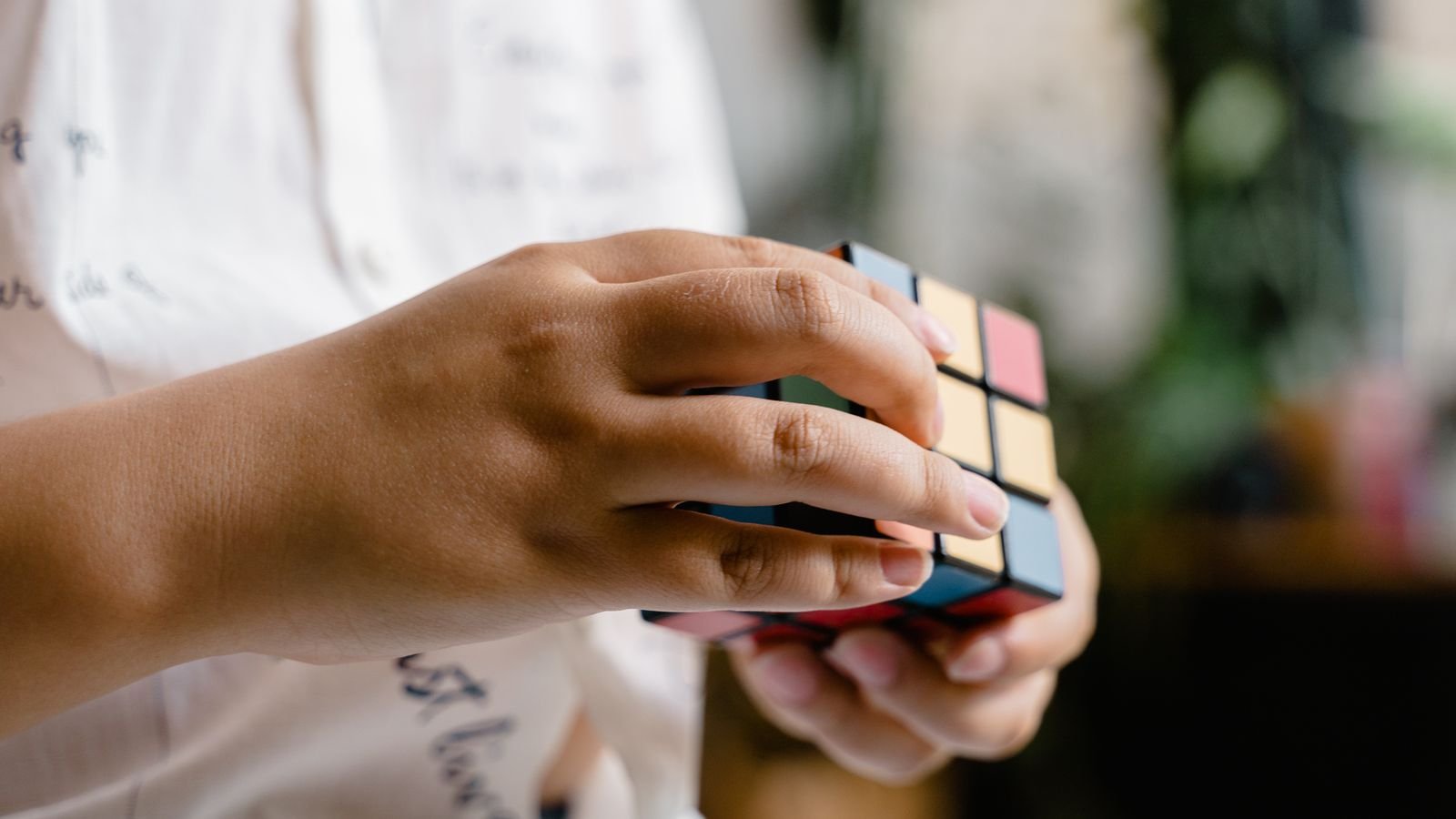
Yes, a six year old can solve a Rubik’s cube from a fully scrambled state, and thousands of them do. What they cannot do is learn it the way most adults try to teach it. Hand a small child a page of letters like R, U and F prime and you will lose them in four minutes. Give them one small win at a time, in the right order, and something lovely happens: they stop asking for help and start showing you.
This guide is the exact order we use with our youngest students, written for a parent who may not be able to solve a cube themselves. You do not need to. You only need to know what comes first, what comes next, and when to stop for the day.
Most children are ready to start the Rubik’s cube at around age 6, because by then they usually have the finger strength to turn the layers and enough working memory to hold a short sequence of moves. Readiness varies more than age does. A child who can follow a three step instruction (“get your shoes, put them by the door, then come back”) and who enjoys building things is usually ready. A child who is still frustrated by their own fingers may be happier starting at 7.
The goal at this age is not speed. It is the finish. A child who solves one cube completely, slowly, with a printed sheet in front of them, has learned something far more valuable than a fast time. They have learned that a mess can be sorted out by following a method, which is exactly the habit we want them carrying into maths homework.
Your child needs three things: a good cube, a fixed short practice slot, and permission to leave it unsolved. The cube matters more than parents expect. The cheap stiff cubes sold at toy counters need real force to turn and they pop apart, which is enough to end a six year old’s interest in a week. A budget speed cube, the kind sold for a few dollars under names like MoYu, QiYi or GAN, turns with a fingertip and corner cuts, meaning it still turns when the layers are not perfectly lined up. Small hands need that forgiveness.
Next, pick a slot of about ten minutes that already exists in your day, such as after dinner or before a bath. Short and daily beats long and occasional, because the cube is a motor skill as much as a thinking skill. Finally, tell your child clearly that they are allowed to put the cube down half solved. Children who believe every session must end in a solve tend to avoid starting.
Before any solving, teach one fact: the centre pieces never move. Each of the six faces has a centre square that is fixed to the core inside. It can spin in place, but it can never travel to another face. That means the white centre defines the white face forever, and the whole puzzle becomes a job of bringing pieces home to their centres rather than a hopeless swirl of colour.
Then name the three kinds of pieces out loud while your child holds the cube. Centres have one colour. Edges, the pieces between two corners, have two colours. Corners have three. Ask your child to find a corner with white, blue and red on it, then a different one. Two minutes of this replaces a whole lesson of confusion later. For notation, skip letters at first. Use “right side up”, “top to the left”, “front clockwise”. Letters can come at age 8 or 9 when they are useful for reading algorithm sheets.
Six facts about the cube your child will love repeating
A standard 3×3 cube can be arranged in 43,252,003,274,489,856,000 different ways. That is 43 with eighteen zeroes after it.
Mathematicians proved that every single one of those positions can be solved in twenty moves or fewer. Cubers call it God’s number.
Ernő Rubik, a Hungarian professor of architecture, built the cube in 1974 and then needed about a month to work out how to solve it.
In February 2026, Teodor Zajder of Poland solved a scrambled cube in 2.76 seconds, the first official solve under three seconds.
The first world championship was won in Budapest with a time of 22.95 seconds. Plenty of school children beat that today.
The six centre squares are attached to a core inside the cube. They spin, but they never swap places, which is the key to solving it.
The first real target is a white cross on the white face, with the sides matching. Ask your child to find the four edge pieces that carry white and bring them around the white centre so they form a plus sign. Then check the second colour on each of those edges. A white and blue edge must sit under the blue centre, a white and red edge under the red centre, and so on. When all four line up, the cube shows a white plus on top and a small T of matching colour on each side.
Let this stage take a week. Do not teach any sequence here. The cross can be solved by moving pieces around intuitively, and that intuition is the single most useful thing a young child gains from cubing. If they get stuck, say “what is stopping that piece from getting home?” rather than reaching for the cube yourself. Most six year olds can finish a correct cross in under two minutes after five or six sessions.
Next come the four white corners, which complete the entire first layer. Turn the cube so the white cross is on the bottom, then hunt for a corner piece with white on it in the top layer. Position it directly above the gap where it belongs, then use one repeating trick until it drops in: turn the right side up, the top to the left, the right side back down, the top to the right. Repeat that same set of four moves and the corner will eventually twist itself into place.
Children love this stage because one trick, repeated, does all the work. Give it a name at home. Our tutors often call it the lift, spin, drop. Naming a sequence turns it from a list of instructions into a single thing a child can remember. By the end of this step your child has a solid white face with matching colours all the way round, and that is the moment most children run to show somebody.
The middle layer needs only one new idea: send an edge piece down to the left or down to the right. Your child looks in the top layer for an edge with no yellow on it, lines its front colour up with the matching centre so it makes an upside down T, then decides which way it needs to travel. There are two mirrored sequences, and each is the same lift, spin, drop trick from step three with a setup move at the start.
This is the point where a six year old will need the sheet in front of them, and that is completely fine. Print the sequences large, in colour, and let them read while they turn. Reading a method and executing it accurately is a genuine skill. After two layers are done, stop for the day, even if there is time left. Ending on a success is what makes a child pick the cube up again tomorrow.
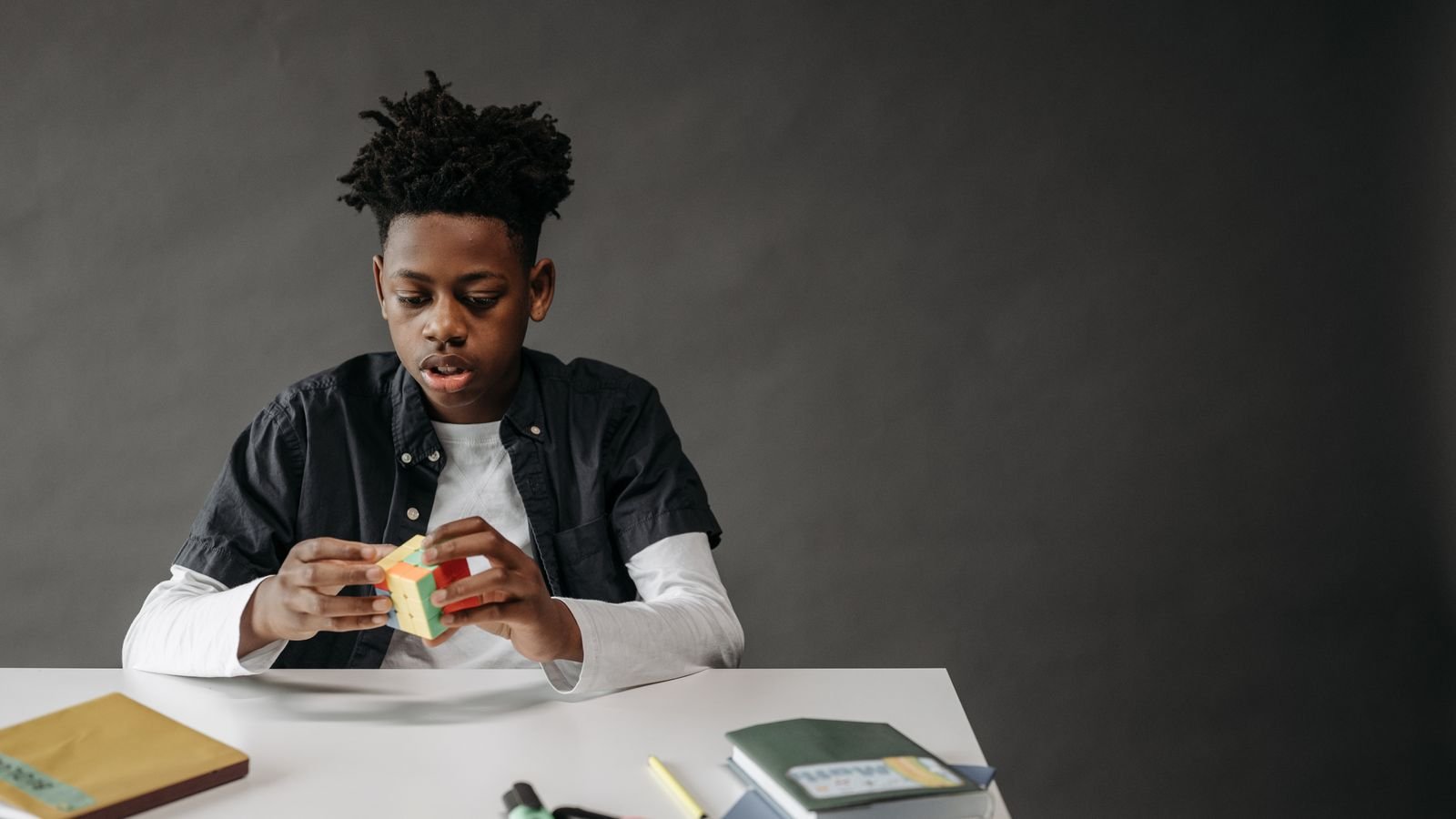
The last layer is not one big hurdle, it is three small ones, and teaching it that way keeps a young child calm. Win one is making a yellow cross on the top, using a single sequence repeated until the cross appears. Win two is getting all the yellow squares facing up, again with one repeated sequence. Win three is putting the last pieces in their correct positions, which needs two more short sequences.
Teach one win per week. A six year old who tries to absorb the whole last layer in one sitting will usually lose the thread and get upset, while a child who spends five days just making yellow crosses will do it without thinking by Friday. When the last piece clicks into place for the first time, make a real fuss. Take a photograph. That memory is what carries them through the next puzzle they meet.
A typical six year old takes three to eight weeks to reach a full solve when practising ten minutes a day. The spread is wide because it depends far more on consistency than on ability. Ten minutes daily beats an hour on Sunday, every time. Expect the first two layers to take about half of that period, and expect a plateau somewhere in the last layer, which is normal and passes.
Good practice looks boring from the outside. It is the same stage, repeated, with a scramble in between. Scramble gently at first, about five to eight random turns, so the cube is genuinely mixed but the path back is short. Increase to a full twenty turn scramble once the whole method is known. After a child can solve reliably, times drop fast on their own, usually from around ten minutes to under three within a month, simply because the fingers get quicker.
Seven things you can try at home this week
Buy a proper speed cube. A cheap stiff cube is the number one reason young children give up. A budget speed cube turns with a fingertip and costs very little.
Set a ten minute timer. Stop when it rings, even mid solve. Children who are stopped while still enjoying it come back tomorrow.
Use colour words, not letters. Say “turn the right side up” instead of R. Notation is useful at 8 or 9, not at 6.
Print the sequences big. Tape one sheet to the wall by the practice spot. Reading and executing is a skill worth building.
Never fix the cube yourself. Taking it out of their hands to “just show you” removes the exact thinking you want them doing. Ask a question instead.
Scramble gently at first. Five to eight turns for the first fortnight, then build up to a full scramble once the method is known.
Celebrate the white cross. Treat the first milestone as a real achievement rather than a step on the way to the real one.
The most common mistake is teaching the whole method in one sitting, and the fix is simply to teach one stage per week. The other four are worth naming too. Second, jumping to letter notation before the child needs it, which turns a colourful puzzle into homework. Third, comparing your child to a video of a speedcuber, which quietly tells them that slow is failing. Fourth, correcting every wrong turn, when a child learns far more from noticing their own mistake three moves later. Fifth, practising only when the child asks, which almost never happens at this age, so a small fixed slot in the day does the remembering for them.
There is one more worth mentioning, because it is the kindest looking of them all. Solving the cube for your child so they can enjoy having a solved cube feels generous, and it teaches them that the finished picture matters more than the process. In a puzzle whose entire value is the process, that is an expensive trade.
A live coach helps most at the two points where videos fail: diagnosing a mistake and adjusting the pace. A video cannot see that your child is holding the cube in the wrong orientation, which is the reason half of all beginner sequences appear not to work. A tutor watching over a video call spots it in seconds, corrects the grip, and the child moves on instead of concluding that they are bad at it.
In our 1 on 1 Rubik’s cube classes at MasterMindz, a tutor works with one child at a time, which means the pace follows that child rather than an average. Some children fly through two layers in a fortnight, others need three weeks on the cross, and both are completely normal. If you want to see how your child responds to that kind of attention before committing to anything, a free trial class is the simplest way to find out.
Read this one out loud to your child
Maya has finished her white cross. It looks perfect from the top: four white edges around the white centre, making a neat plus sign. But when she starts on the corners, every corner she puts in seems to break something else. Her cross is definitely white. So what has gone wrong?
Tap a question to reveal the answer
A solved cube is a nice photograph. The thing worth having is what your child learns on the way there: that a mess is not permanent, that a method is worth trusting even when it feels slow, and that they can be the person in the room who finishes something hard. Studies from the University of Minnesota on Rubik’s cube training and spatial skills and later work on how students learn the cube point the same way, and the cubing world itself, tracked by the governing body behind records like the one reported by the University of Cincinnati, is now full of children who started exactly where yours is starting.
Start tonight with ten minutes and the white cross. That is the whole first week.
More for curious parents
MasterMindz teaches children worldwide through live, personal 1 on 1 online classes in chess, maths, coding, Rubik’s cube and more, with experienced tutors and a fun, individual approach. MasterMindz has taught 750+ students across 11+ countries.