September 10, 2026
Yes, learning music online genuinely works for young children, with one condition: the lesson has to be live and one to one.


Cards, dice and a kitchen table. That is the whole kit.
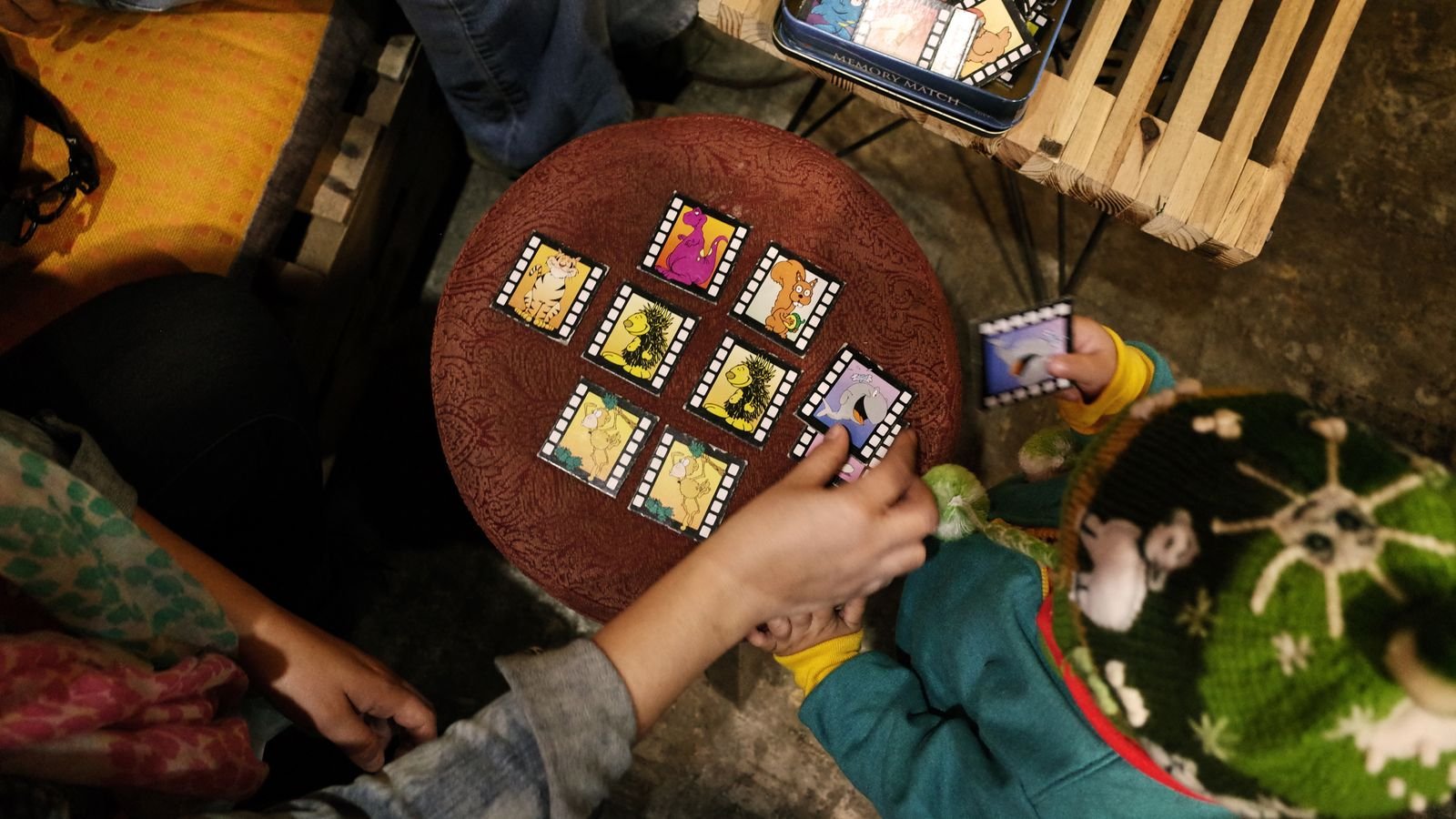
The fastest way to make a child better at maths at home is not a worksheet. It is a game with a winner, played out loud, for about ten minutes. Numbers stop being something to get right and start being something to use, and that shift in feeling is what carries into the classroom.
Below are ten games that need no app, no subscription and no screen. Most cost nothing at all. They are grouped by what you need to play them, so you can pick one based on whatever is within arm’s reach right now, whether that is a pack of cards in a drawer or absolutely nothing on a walk to school.
Screen free maths games work because they force a child to say numbers out loud, handle real objects and make decisions that another person can see. A tablet game gives instant feedback and moves on. A card game makes your child hold a number in their head, compare it to yours, and explain why they think they have won. That extra half second of reasoning is where the learning sits.
There is solid research behind this. A meta-analysis by the HEDCO Institute at the University of Oregon reviewed 18 studies of number board games and found that even a few short play sessions improved skills such as counting, identifying numerals and comparing quantities in children from preschool to second grade. These were not elaborate programmes. They were simple games where a child moves a piece along a numbered path.
The other reason games work is the adult in the room. Researchers at the University of Chicago tracked hundreds of first graders and found that children whose families regularly did short maths activities together gained ground on their peers, with the biggest benefit going to children whose parents were themselves nervous about maths. You do not need to be good at maths for this to work. You need to be present and relaxed about it.
A standard deck of playing cards is the single best maths toy you can own, because every card is already a number and every hand deals itself. Remove the picture cards for younger children, or keep them as 11, 12 and 13 for older ones. Ace counts as 1.
Split the deck in two. Each player flips a card at the same time and the higher card wins both. If the cards match, flip again and the winner takes all four. This teaches comparison, which is the foundation of number sense. To make it harder, each player flips two cards and adds them, and the bigger total wins.
Lay out twelve cards face up in a grid. Players take turns removing any two cards that add to ten. When nobody can find a pair, refill the gaps from the deck. The player with the most cards at the end wins. Number bonds to ten are the single most useful thing a young child can memorise, and this game drills them without a single flashcard.
Deal four cards face up. Using each card exactly once and any operations you like, be the first to reach 24. If the cards are 8, 4, 6 and 2, one route is 8 times 4, which gives 32, then subtract 6 and subtract 2 to land on 24. There is often more than one way there, which is exactly the point. This is genuine problem solving dressed up as a race.
Six things to say out loud at the table tonight
Add the values 1 to 13 and you get 91. Multiply by the four suits and you get 364. Add one joker and you land on 365, the number of days in a year.
Dice have been found at archaeological sites thousands of years old, which makes them one of the oldest maths tools humans have ever used.
On a standard die, opposite faces always add to seven. One faces six, two faces five, three faces four. Check it tonight.
The game began in India as Moksha Patam, a board designed to teach children about good and bad choices long before it became a toy.
Humans can see up to about four objects instantly without counting them. It is called subitising, and it is why dice patterns are so easy to read.
If the digits of a number add up to a multiple of nine, the whole number divides by nine. Try 4,158. Four plus one plus five plus eight equals eighteen, and eighteen divides by nine.
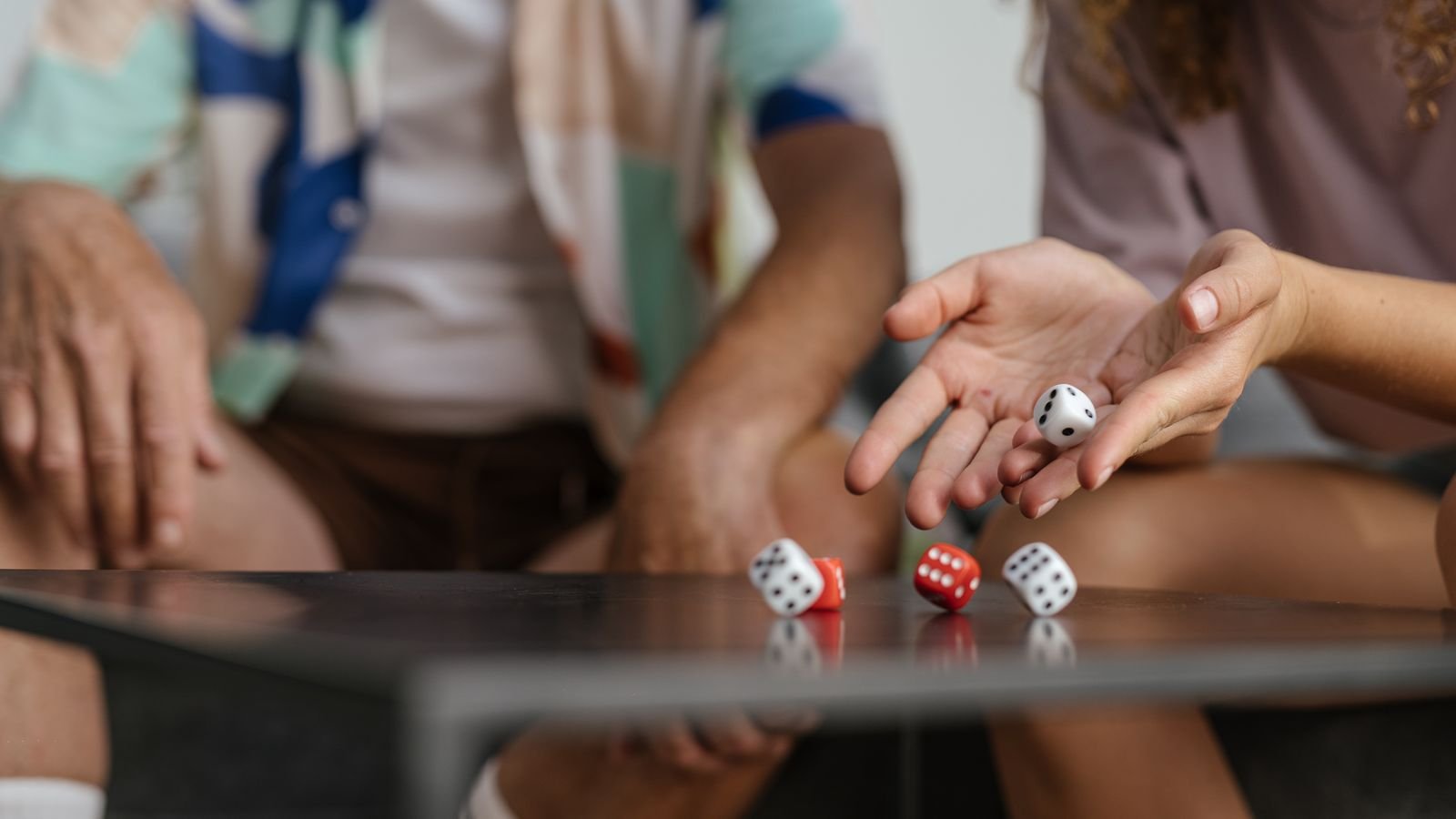
Dice games train speed and probability at the same time, because a child has to add quickly and then decide whether to risk another roll. Two dice from any old board game are enough for all three below.
Roll one die repeatedly and keep a running total. You may stop whenever you like and bank your score. But if you roll a one, you lose everything gained that turn and hand over the die. First to 100 wins. Children learn addition fluency and, more interestingly, they start reasoning about risk. Ask them after a few rounds what number they think is a smart moment to stop.
Both players roll two dice and multiply their own numbers. Higher product wins the round. Play first to ten points. It sounds almost too simple, but it produces around sixty multiplication calculations in five minutes, and children do not notice because they are watching your dice, not their own.
Write the numbers 2 to 12 on a scrap of paper. Roll two dice, add them, and cross off that number. First to cross off everything wins. Children quickly discover that 7 comes up far more often than 2 or 12, which is their first real encounter with probability. Ask them why, and let them work it out rather than telling them.
Kitchen maths is the most useful kind, because the answer has a consequence your child can taste. Fractions, ratios and measurement stop being abstract when getting them wrong means the pancakes are wrong.
Pick any recipe and tell your child you are making half of it, or one and a half times it. They must convert every quantity before you are allowed to start cooking. Three quarters of a cup halved, 250 grams multiplied by 1.5, twelve minutes of baking for a smaller tin. This is fraction and ratio work that would take a whole worksheet, done in four minutes because dinner depends on it.
Hand your child the shopping receipt with the total covered. They estimate the total first, then add it up properly and see how close they were. Younger children can simply find the most expensive item, or all the items under two dollars. Estimation is a badly underrated skill, and this is the cheapest way to practise it.
These two need no equipment, which makes them perfect for car journeys, queues and the walk to school. They are also the ones children ask to play again.
Think of a number between 1 and 100. Your child asks questions that can only be answered yes or no, and tries to find it in as few questions as possible. Good players quickly discover that halving the range each time beats guessing at random. That is binary search, and children work it out on their own by about the fourth game.
Take the digits on the next car number plate you see and race to make the biggest possible total using any operations. A plate with 4, 7 and 2 might give 4 times 7 plus 2, which is 30, or 47 times 2, which is 94. Order of operations, place value and mental arithmetic, all from a passing car.
The moment a game starts feeling like an assessment, its value drops sharply. Children can tell the difference between a parent who is playing and a parent who is checking. The fix is mostly about what you say, not what you play.
Play to win, genuinely. A child who beats you honestly learns far more than one who is allowed to win. Keep sessions short and stop while they still want more, ideally around ten minutes. Never correct mid move. Let the wrong answer play out and let the game reveal it, then talk about it after.
Watch your own language too. University of Chicago research found that parents who are anxious about maths can pass that anxiety on, particularly when helping with homework. Saying “I was never a maths person either” feels supportive but hands your child a ready made excuse. Try “let me think about that one too” instead.
Simple things you can try at home this week
Pick a slot, not a plan. Ten minutes after dinner beats a grand Sunday schedule that never happens. Same time, same place, no announcement.
Let your child be the scorekeeper. Keeping score is itself the maths. Hand them the paper and pencil and stay out of it.
Ask “how did you get that?” even when they are right. If you only ask after wrong answers, the question becomes a warning sign. Ask both ways and it becomes a conversation.
Play one level above comfortable. If they win every round, add a rule. If they lose every round, remove one. The sweet spot is roughly winning half the time.
Say the numbers out loud. Silent mental maths hides mistakes. Talking through a calculation is how you find out where the gap actually is.
Keep the kit visible. A deck of cards and two dice in a small tin on the table gets used. The same items in a cupboard do not.
End on a win, not a lesson. Finish the session with a round your child is likely to enjoy, and resist the urge to summarise what they learned.
Read it aloud and let your child think before you tap
What number comes next in this sequence?
Tap a question to reveal the answer
Match the game to what your child is currently learning at school, not to how clever you think they are. A stretched child gives up and a bored child drifts, and both look the same from the outside.
Ages 4 to 6. Number War, Roll and Cover and Guess My Number with a smaller range, such as 1 to 20. The goal here is counting confidently, recognising written numerals and understanding that six is more than four.
Ages 7 to 9. Make Ten, Pig, Times Table Duel and Receipt Detective. This is the fluency window, where addition facts and times tables should become automatic. Speed games are ideal.
Ages 10 to 12. Target Twenty Four, Half the Recipe and the Number Plate Challenge. At this age the value is in reasoning, fractions, ratios and order of operations rather than raw arithmetic.
Games fix attitude. They rarely fix understanding on their own. If your child enjoys these games but still freezes on schoolwork, the issue is usually a specific missing foundation, often fractions, place value or division, and it will not resolve by playing more rounds of Pig.
That is where a teacher watching one child, rather than thirty, makes the difference. In a live 1 on 1 class a tutor can see the exact moment your child hesitates and trace it back to the concept underneath. Play the games for the love of numbers. Bring in structured teaching for the gaps.
More for curious parents
MasterMindz offers live 1 on 1 online classes for children and has taught 750+ students across 11+ countries, including families in Singapore, Dubai, Australia, the United States and Romania. We teach maths, chess, coding, Rubik’s cube, music and languages, with one tutor and one child in every class. The first trial class is free and there is no commitment.