September 10, 2026
Yes, learning music online genuinely works for young children, with one condition: the lesson has to be live and one to one.


The seven stages, the right age to start, and how to get from scrambled to solved without a single tear.
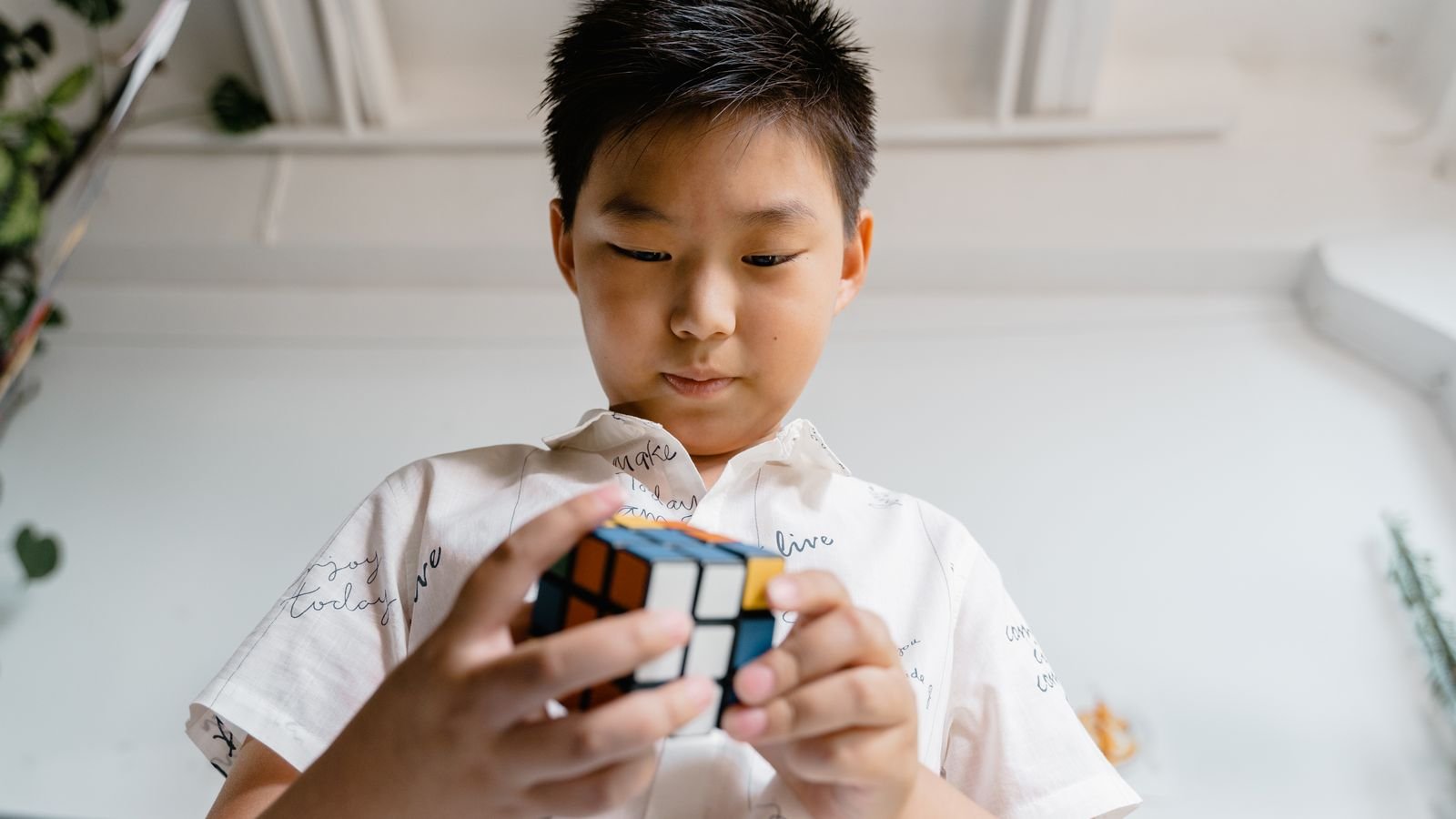
A child can learn to solve a Rubik’s cube, completely, all six faces, in about four to eight weeks. Not four years. Not with a special brain. The reason so few people manage it is not difficulty, it is that almost nobody is ever shown the method. They twist hopefully for ten minutes, get nowhere, and put it in a drawer.
This guide is written for parents who want to sit down with their child and actually get to the finish line. It covers what is happening inside the cube, the notation, the seven stages of the beginner method, how long each stage usually takes, and the small mistakes that quietly make children quit. You do not need to know how to solve it yourself to help.
A Rubik’s cube is not 27 loose blocks that float around freely. It is a fixed skeleton of six centre pieces that never change position, with 8 corner pieces and 12 edge pieces rotating around them. Once your child understands this, the whole puzzle changes character.
Look at the cube and find the white centre square. That square is bolted to the core. It cannot travel. Which means the white face will always be the white face, no matter how scrambled things look. The same is true for the other five colours. So the job is not to invent an arrangement that looks tidy. The job is to walk each corner and each edge home to the centre it belongs beside.
Two more things worth pointing out to a child. A corner piece has three colours on it and can only ever live in a corner. An edge piece has two colours and can only ever live in an edge slot. Pieces cannot change what they are. Suddenly the cube stops feeling like chaos and starts feeling like a delivery job with twenty parcels.
Cube notation is just six letters, one for each face, and every tutorial in the world uses the same six. Learning them takes about fifteen minutes and it unlocks every instruction your child will ever read.
An apostrophe means turn it the other way, so R’ is the right face anti-clockwise. A number 2 means turn it twice, so U2 is two turns of the top. Clockwise always means clockwise as if you were looking straight at that face, which is the part children get wrong at first with the back and the left.
One rule matters more than the rest: hold the cube still. The most common beginner error is spinning the whole cube in your hands halfway through a sequence, which means R is no longer pointing where it was. Tell your child to pick a front face and keep it facing them until the sequence is finished.
Six facts to read aloud before your child starts twisting
Erno Rubik, an architecture professor in Budapest, built the first cube in 1974 to help his students picture shapes turning in three dimensions. He called it the Magic Cube.
A 3×3 cube can be arranged in 43,252,003,274,489,856,000 ways. Exactly one of them is solved. Guessing is not a plan.
Mathematicians proved that any scramble in the world can be solved in 20 moves or fewer. Cubers call this number God’s Number.
The official world record for a single solve is 2.76 seconds, set by Teodor Zajder at a competition in Poland in February 2026.
The beginner method your child will learn uses roughly 5 to 7 short move sequences in total. That is less to memorise than a school poem.
Blindfolded solving is a real competitive event. Cubers memorise the whole scramble first, then put the blindfold on and solve from memory.
Almost every child learns using the layer by layer method, which breaks the cube into seven small stages solved in a fixed order: bottom layer, then middle layer, then top layer. You never go backwards, and each stage protects the work already done.
Stages 1 to 3 feel like a puzzle your child solves with their own thinking. Stages 4 to 7 feel more like a recipe. That shift is normal, and it is worth warning children about, because some feel briefly cheated when the last layer becomes “just follow the steps”. Explain that professional cubers use exactly the same idea, only with more recipes to choose from.
Most children who practise ten to fifteen minutes a day learn the full solve in four to eight weeks. With one to one guidance it is often faster, because a tutor spots the exact stage where the child is stuck instead of letting them re-watch a video for a week.
A realistic timeline looks like this. The white cross usually falls on day one or two. The first full layer takes most children another few days. The middle layer often lands inside the first two weeks. Then the last layer, stages four to seven, takes as long as everything before it combined, because that is where the memorising happens. This is the point at which children quit, so it helps enormously if a parent knows in advance that the wall is coming and that it is normal.
Speed comes later and it comes quickly. A child who takes four minutes on their first solve is usually under two minutes within a month of casual practice, simply from repetition. If they get interested in going faster, there is a whole world of competition times published by the World Cube Association, and a fascinating history of record solves going back to the 1980s.
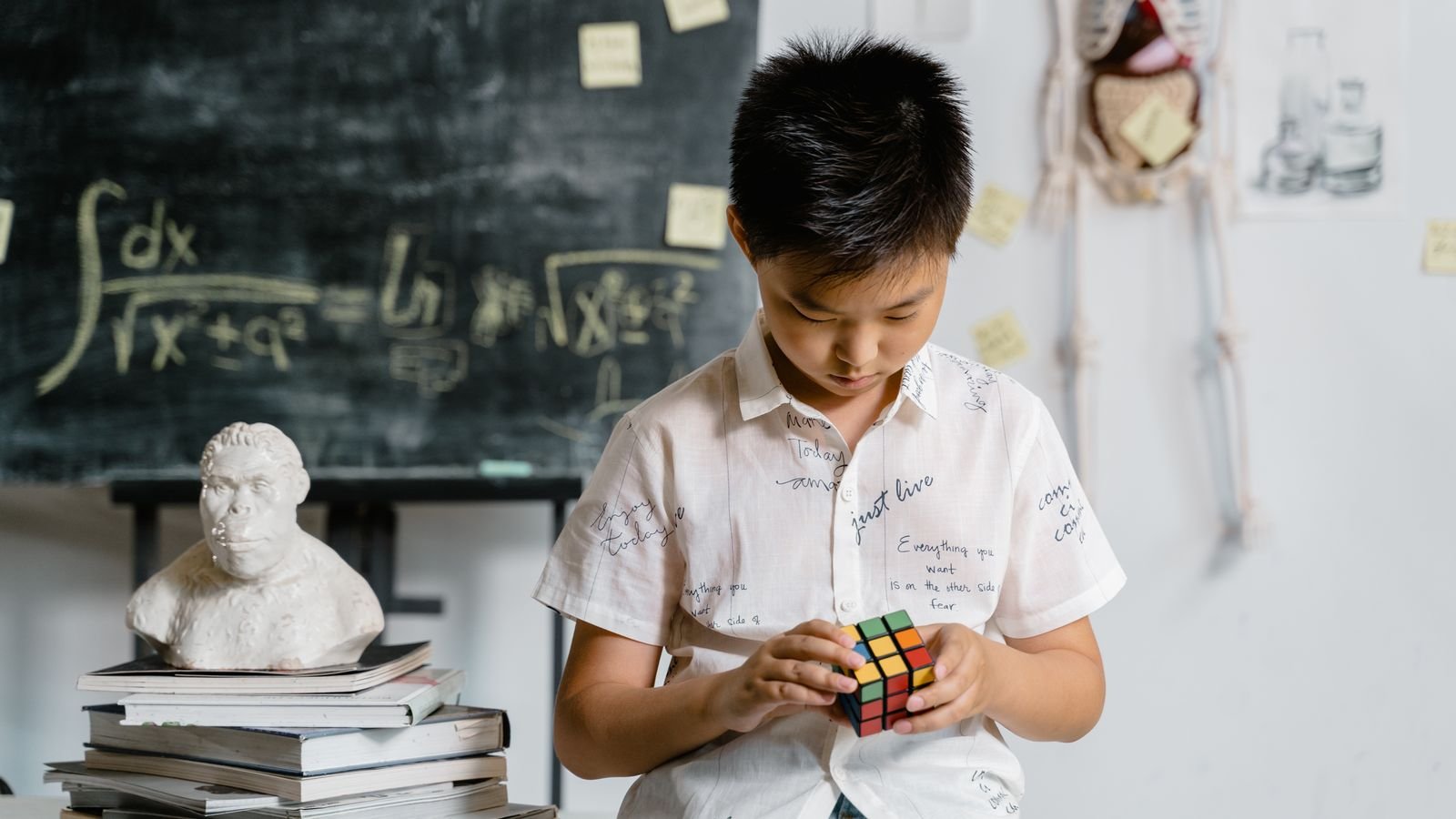
Most children are ready for the full 3×3 cube at around age 7, and plenty of six year olds get there with an adult sitting beside them. What matters is not intelligence, it is finger control and the patience to repeat a sequence without losing interest halfway.
For ages 4 to 6, start with a 2×2 pocket cube. It has no centres and no edges, only corners, so a small child can genuinely solve it and feel the win. Colour sorting games and simple pattern matching on the 3×3 also work well at this age, without any pressure to complete it.
From 7 to 9, the standard beginner method is a good fit. Children in this range often love the ritual of it, and many enjoy teaching the method to a parent or a younger sibling. From 10 upwards, a lot of children want the timer, the faster turning, and eventually the competitions. That is when cubing turns from a party trick into a hobby they keep for years.
The main benefit is spatial reasoning, the ability to picture an object rotating in your head before your hands move it. This is the skill a child uses to imagine where the blue corner will land after three turns, and it is one of the better predictors of later performance in science, technology, engineering and maths.
Encouragingly, it is not fixed at birth. A large review by researchers at Northwestern University found that spatial skills improve with training and the improvement lasts, in children and adults alike. Later work has found that spatial training in primary school children can even carry across into a range of mathematics skills. A cube is not a magic pill, but it is one of the cheapest, most repeatable pieces of spatial practice a child can hold in their hands.
There are three quieter benefits parents notice first. Working memory, because holding a seven move sequence in your head while your fingers execute it is real mental load. Algorithmic thinking, because a cube sequence is precisely what a function is in coding: a fixed set of steps with a predictable result. And frustration tolerance, which may be the most valuable of all. A cube gives a child a controlled, safe experience of being stuck, trying again, and eventually winning. That loop is hard to teach in words.
Seven things you can try at home this week
Aim for one layer, not the cube. Tell your child the goal this week is the white face and the first layer only. Finishing something small keeps them in the game far better than a distant finish line.
Ten minutes a day beats two hours on Sunday. Muscle memory for sequences builds through frequency, not through long sessions. Keep the cube on the dining table, not in a cupboard.
Say the moves out loud. Getting a child to chant “R, U, R prime, U prime” while turning locks the sequence in much faster than silent copying, and you can hear immediately where they went wrong.
Put a sticker on the front face. A small dot on the front centre stops the classic beginner mistake of rotating the whole cube mid sequence and losing track of which side is which.
No timer until the first solve. Timing a child who is still learning turns a puzzle into a test. Bring the stopwatch out only once they can complete the cube unaided.
Let them teach you. Ask your child to teach you the white cross. Explaining a method forces them to organise it, and it is the fastest way to move knowledge from shaky to solid.
Scramble properly. Twenty random turns, including some of the middle and back faces. A lazy scramble leaves the cube nearly solved and teaches nothing.
Try this with a solved cube. It surprises almost everybody.
Take a solved cube. Do this four move sequence: R, U, R’, U’ (right face clockwise, top clockwise, right face anti-clockwise, top anti-clockwise). The cube now looks scrambled. Keep repeating the exact same four moves without stopping.
How many times must you repeat the sequence before the cube returns to solved?
Tap a question to reveal the answer
Almost every child who abandons the cube does so for one of five reasons, and all five are fixable in a single sitting. Knowing them in advance is genuinely the difference between a solved cube and a drawer.
Buy an inexpensive modern speed cube rather than the classic stiff original. Modern cubes are designed to turn even when the layers are not perfectly aligned, a feature called corner cutting, and it removes most of the physical frustration a beginner meets.
Choose stickerless if you can, because the colours are moulded into the plastic and will never peel off in a moment of temptation. Avoid the tempting bundle sets with a 4×4 and 5×5 included until the 3×3 is genuinely solved, since a bigger cube is not a harder version of the same puzzle, it is a different puzzle that builds on the 3×3 method. And avoid magnetic cubes at the start. They are wonderful for speed but the extra snap can confuse a child still learning where the faces are.
The Rubik’s cube has a reputation for genius that it does not deserve. It is a puzzle with a published method, six letters of notation and seven stages, and children work through it every day all over the world. What it really asks for is the willingness to keep going through the middle part, which happens to be the exact quality most parents wish they could hand their child.
If your child has been staring at a scrambled cube and getting nowhere, the fastest fix is usually not another video. It is one hour with someone who can watch their hands and say “stop, you turned the whole cube there”. That is what a live 1 on 1 class is for, and it is why so many children who were stuck for months finish their first layer in a single session.
More for curious parents
MasterMindz teaches children worldwide through live, personal 1 on 1 online classes in chess, maths, coding, Rubik’s cube and more, with experienced tutors and a fun, individual approach. MasterMindz has taught 750+ students across 11+ countries, and every child starts with a free trial class before deciding anything.