September 28, 2026
Online classes are working when your child is more engaged, more skilled and more independent than a few weeks ago. Here is what to look for at 4, 8 and 12 weeks.


Most family routines die quietly by week three. Here is how to build one that holds through homework, activities and exam weeks.

Every term starts the same way. On a Sunday evening in early January or August, a beautiful timetable gets drawn up, colour coded, stuck to the fridge. By the third week it is quietly ignored, and the homework battle is back. This is not a discipline problem and it is not a sign that your child is disorganised. It is almost always a design problem, and the design can be fixed.
What follows is a practical method rather than a philosophy: what to fix, what to leave loose, what to expect at each age, and what to do on the days it falls apart. It works for a five year old who cannot read a clock and for a fourteen year old who has three deadlines and no plan.
For a child, time management has very little to do with clocks. It is the ability to start a task without being told, stay with it while it is boring, and stop when it is finished. Psychologists call this self regulation, and it is one of the strongest predictors of how school will go.
That distinction matters because it changes what you are actually teaching. A child who cannot get started does not need a better schedule, they need a smaller first step. A child who starts fine but drifts after four minutes needs a shorter block, not a longer lecture. Both look like “bad at time management” from the outside and they need opposite fixes.
There is also a hard developmental limit worth knowing. Children under about ten have a genuinely poor sense of duration. Ask a seven year old how long twenty minutes is and you will get anything from two minutes to an hour. Expecting them to budget time they cannot yet feel is like asking them to budget money in a currency they have never seen.
Most family routines fail because they are designed for the best possible week rather than the average one. The Sunday night version assumes nobody is tired, nothing runs late, and every activity ends on time. Then one Tuesday goes wrong, the whole plan is behind, and the plan gets abandoned rather than adjusted.
Three specific design faults cause nearly all of it. The first is too many slots: a plan with nine items has nine chances to fail, and one failure makes the rest look pointless. The second is no slack, which means a single overrun cascades through the evening. The third, and the most common, is that the routine depends entirely on a parent enforcing it, so it works when you are calm and available and dies on the days you are not.
The fix is not more discipline. It is fewer moving parts, deliberate empty space, and a version simple enough that your child can run it without you standing there. Routines that hold are almost always the boring, sparse ones. A systematic review of research on routines and child development found consistent links to better cognitive, self regulation and academic outcomes, and consistency is the operative word in that sentence.
Six findings on routines, sleep and self control
A systematic review screened 4,297 papers and found 170 that met its criteria. Routines were consistently linked to positive developmental outcomes.
Children aged 6 to 12 need 9 to 12 hours of sleep, and teenagers 8 to 10. Everything else in the evening has to fit around that.
Paediatric guidance recommends switching screens off about half an hour before bed and keeping them out of the bedroom entirely.
The same review highlighted that predictable routines act as a protective factor for children growing up in high stress environments.
Regular routines are associated with better impulse control, attention and emotional regulation, because a child who knows what comes next argues about it less.
Children who start school with stronger self regulation have been found to show higher maths and literacy achievement years later.
Start with three fixed points and let everything else float between them: wake time, dinner time and lights out. These three anchors do more work than a full timetable, because they are the only times that genuinely cannot move without consequences.
Build them backwards from sleep rather than forwards from the school bell. Take a nine year old who wakes at 6:45am. At the middle of the recommended range, that means lights out at around 8:30pm, which means the wind down starts at 8:00pm, which means everything else has to finish by then. Written out that way, most families discover their evening is roughly ninety minutes shorter than they had been planning for. That single realisation solves more routine problems than any chart. The sleep duration guidance from the American Academy of Sleep Medicine is worth checking against your child’s actual bedtime before you plan anything else.
Once the anchors are set, resist the urge to fill the gaps. Say what has to happen between dinner and wind down, not exactly when. A child who knows “homework and one activity before 8pm” has room to negotiate the order, and that small amount of control is often the difference between cooperation and a fight.
A school evening that actually works has only four blocks: decompress, focused work, one activity, and wind down. Any plan with more than four parts is a plan that will be abandoned.
Block 1, decompress, 30 to 45 minutes. No homework straight off the bus. Children have been regulating themselves for six or seven hours and have nothing left. Snack, movement, talking. Parents who skip this block spend the saved time arguing later.
Block 2, focused work, 20 to 45 minutes by age. One block, not three. If homework genuinely needs longer, split it with a five minute break rather than extending. Put the hardest subject first, while attention is still available.
Block 3, one activity. Sport, music, a class, a hobby. One, not two. This is the block families overfill, and the overfilled version is what breaks the whole week. A single 50 minute live class, which is the length we run at MasterMindz, sits comfortably here. Three commitments do not.
Block 4, wind down, 30 minutes. Screens off, lights lower, something quiet. This block is the one most often sacrificed and the one that most directly protects the next morning.
Notice what is missing: there is no slot labelled “free time” squeezed between two others. Free time is what fills the gaps when a block finishes early, and it is the reward that makes the rest of the structure worth keeping.
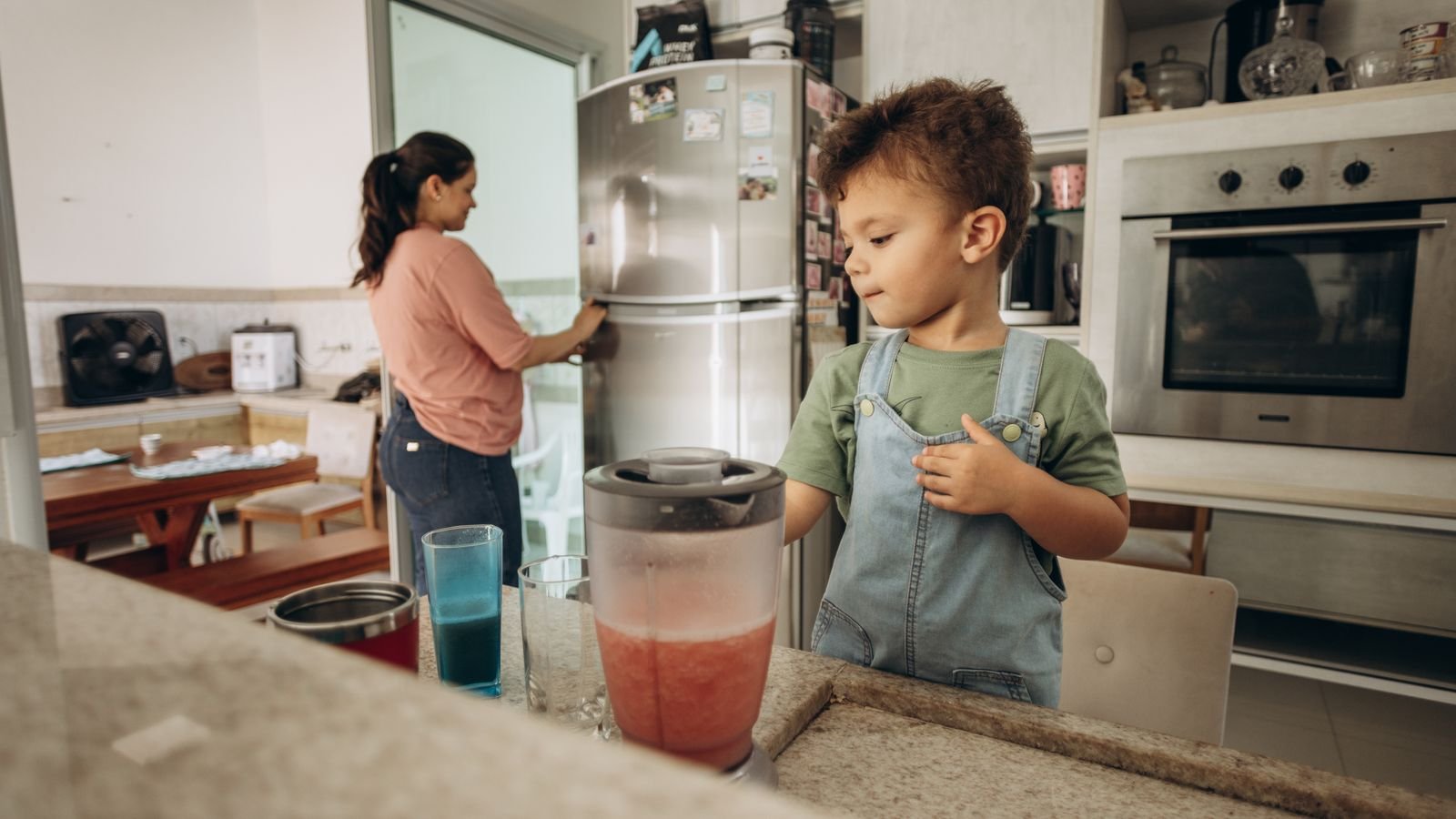
The routine should hand over responsibility gradually, moving from pictures to checklists to the child’s own plan. Trying to skip a stage is what produces a twelve year old who still needs reminding four times.
Ages 5 to 7. Use pictures, not words. Four or five drawn steps on a card by the door. Two blocks in the evening at most, with focused work capped at 10 to 15 minutes. Your child is not managing time yet, they are learning that the day has a shape.
Ages 8 to 10. Move to a written checklist your child reads themselves, and introduce a visible timer. Focused work of 20 to 30 minutes. The key change here is that you point at the list instead of giving the instruction, which quietly transfers the nagging from you to the paper.
Ages 11 to 13. Your child drafts the week on Sunday and you review it rather than write it. Focused work of 30 to 45 minutes. Introduce a five minute weekly look back: what worked, what did not, what changes. This is the age where a routine becomes something they own rather than something done to them.
Ages 14 to 15. Step back to a weekly check in only. They plan the days, you check the week. Expect them to get it wrong sometimes, and let the natural consequence teach it, because a missed deadline at fourteen is a far cheaper lesson than a missed one at nineteen.
Children manage time better once they can estimate it, and estimation is trainable in a few weeks. The method is simple: guess, then measure, then compare. Before a task, ask how long they think it will take. Time it. Discuss the gap without judging it.
Most children start out wildly optimistic about the things they dislike and wildly pessimistic about the things they enjoy. Within a month of guessing and checking, the estimates tighten considerably, and something more valuable appears with them: the child stops experiencing homework as an endless void and starts seeing it as a thing with a known size.
A visible timer helps enormously at every age, because it turns time into something spatial. So does chunking, which means naming the work in units your child can count. “Six questions” is manageable. “Do your maths” is not. Chess players learn a version of this early, since a clock forces you to notice how long thinking actually takes, and that awareness carries straight into homework.
Plan the recovery before you need it, because the routine will break and the question is only how fast you get back. Exam weeks, illness, holidays, a school trip, a bad fortnight. None of these are failures of the system, they are the normal weather of a school term.
Write a minimum version now, while things are calm. Three items only: something like homework started before dinner, screens off by eight, lights out on time. On the hard days you run the minimum version and nothing else, and it counts as a success. This one idea does more to keep routines alive than any reward chart, because it removes the all-or-nothing thinking that kills them.
Then hold one reset conversation per term, roughly at the halfway point. Fifteen minutes, three questions: what is working, what is not, what should we change. Let your child answer first. Routines that get renegotiated survive. Routines that get enforced without discussion get quietly abandoned instead, usually somewhere around week three.
Simple things you can try at home this week
Fix bedtime first, then work backwards. Decide lights out, subtract the wind down, and see what is genuinely left. Plan into that, not into wishful thinking.
Cut the plan to four blocks. If your current routine has seven steps, delete three. Fewer items survive contact with a real Tuesday.
Put the list on the wall, not in your head. Point at the chart instead of giving the instruction. The paper becomes the authority and you stop being the nag.
Protect the first 30 minutes after school. No homework, no questions about marks. Snack and movement. Everything after it goes better.
Use a visible timer for focused work. A dial your child can see turns an abstract twenty minutes into something with a shape.
Write the minimum version today. Three non-negotiables for bad days, agreed in advance, so a hard week bends the routine instead of breaking it.
Review on Sunday, for five minutes. What worked, what did not, one change. Short and regular beats long and occasional.
Read Aarav’s Tuesday plan with your child and find the flaw
Aarav is 9 years old. His alarm goes off at 6:30am every school day. Here is his Tuesday:
Home 3:45pm · Homework 4:00pm · Chess class 5:00pm · Dinner 6:15pm · Free time 7:00pm · Lights out 10:15pm
Tap a question to reveal the answer
Do not redesign the whole term tonight. Set the three anchors, cut the evening to four blocks, and run it for seven days. Then sit down for five minutes on Sunday and change one thing. A routine built this way tends to still be standing in November, which is more than can be said for the colour coded version on the fridge.
If your child’s one activity slot is still open, a live 1 on 1 class is a straightforward way to fill it without adding travel or chaos to the week. The first trial class is free, and it takes 50 minutes to find out whether it fits your evenings.
More for curious parents
MasterMindz offers live 1 on 1 online classes for children and has taught 750+ students across 11+ countries. We teach chess, maths, coding, Rubik’s cube, music and languages in personal one-to-one lessons, with flexible timings that work across Singapore, Dubai, Australia, the US and beyond.