September 28, 2026
The Singapore maths bar model is a simple drawing method that helps children see what is known, what is missing and which operation to use in a word problem.


What most children can do at each age from 5 to 14, the signs that actually matter, and what to do if something is missing.
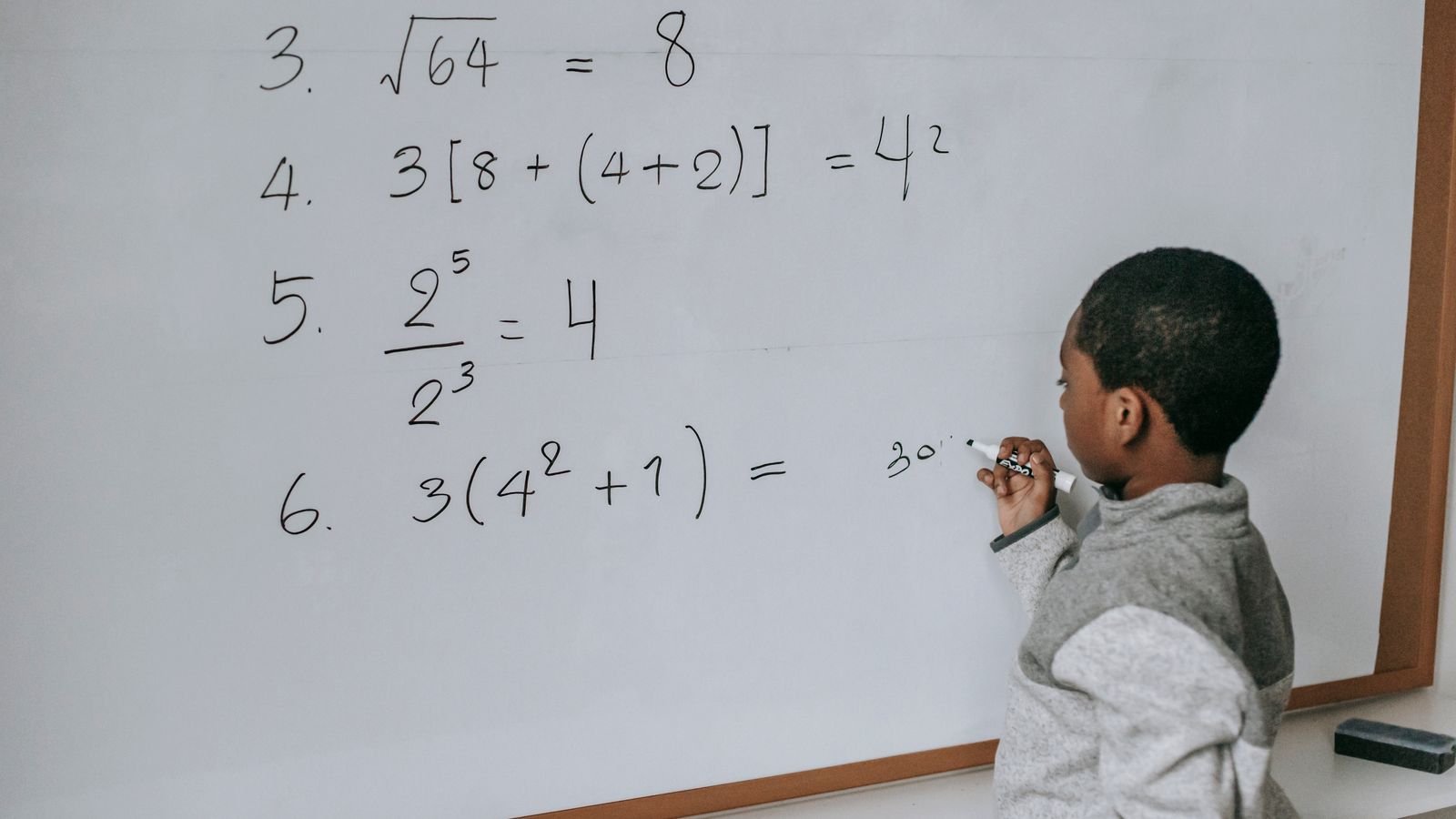
Almost every parent has this thought at some point, usually while watching a child stare at a homework sheet for far too long. Is this normal for their age, or is my child falling behind? It is a fair question and a hard one, because school reports are written in language designed not to alarm anybody.
Below is a plain checklist of what most children can do at each age from 5 to 14, based on the structure of the England national curriculum, which is also the backbone of many international school programmes. Read it as a map rather than a scoreboard. Children move through these stages at genuinely different speeds, and being early or late in one area says very little on its own.
Being behind in maths almost always means a missing building block from an earlier year, not a failure to grasp this term’s topic. Maths is the most cumulative subject a child studies. You cannot understand equivalent fractions without place value. You cannot do algebra without confident negative numbers. You cannot do percentages without division. So when a child suddenly struggles in Year 7, the actual gap is very often sitting quietly in Year 4.
This is why re-teaching the current topic frequently fails. The child listens to the same lesson again, understands it in the room, and still cannot do the homework, because the missing piece is two years upstream and nobody has gone looking for it. Finding that piece is the entire job. Once it is filled, children often catch up much faster than anyone expected, because they were never short of ability, only of one foundation.
At this stage most children can count forwards and backwards to 100, read and write numbers up to at least 20 in both figures and words, and understand that in a two-digit number the first digit means tens. They add and subtract within 20 without needing objects every time, recognise halves and quarters, name common flat and solid shapes, and tell the time to the hour and half hour.
The thing that matters most here is not counting but understanding that numbers represent quantities. A child who can recite to 100 but cannot say whether 8 is more than 5 has learned a song rather than a number system.
Worth a closer look if: your child still counts every object one by one to find a total by the end of this stage, cannot say which of two small numbers is larger without counting, or reverses digits consistently when writing numbers past the age of six and a half.
Six things worth knowing before you decide your child is behind
England’s national curriculum lists fluency, meaning rapid and accurate recall, as the first aim of school maths, ahead of reasoning and problem solving.
Children are expected to know all multiplication and division facts up to 12 x 12 by the end of Year 4, which is around age nine.
Fractions and decimals are where many confident children first stumble, because multiplying can now make a number smaller and the old rules stop applying.
Because maths builds on itself, a gap left in Year 4 usually shows up as a Year 7 problem wearing a different name.
Where a child is at one age is a snapshot, not a prediction. What happens next matters far more than the snapshot itself.
A child who has quietly stopped trying will score much like a child who never learned it. The two need completely different responses.
This is the stage where maths stops being about counting and starts being about knowing. Most children can add and subtract three-digit numbers using a written column method, are working steadily towards all times tables up to 12 x 12, understand tenths and simple fractions of amounts, measure in millimetres, centimetres and metres, and tell the time to the minute on both digital and analogue clocks.
Times tables deserve special mention because they are the hinge of the whole primary curriculum. The statutory programme of study for mathematics expects children to know all multiplication and division facts to 12 x 12 by the end of Year 4. A child who leaves this stage without them will find that every later topic, from long division to fractions to ratio, costs them more effort than it costs their classmates.
Worth a closer look if: your child still counts on fingers for facts they have been taught for two years, cannot recall any table beyond twos, fives and tens by the end of age eight, or writes column sums with the digits misaligned.
If your child was fine and then suddenly was not, this is usually where it happened. At this stage children work with long multiplication and formal division, convert between fractions, decimals and percentages, meet negative numbers, calculate area and perimeter, and start to follow the order of operations rather than simply working left to right.
Fractions are the genuine difficulty. Up to this point, every rule a child has learned has been reliable: multiplying makes things bigger, dividing makes them smaller, and a longer number is a larger number. Fractions and decimals break all three of those at once. Half of eight is smaller than eight. 0.9 is bigger than 0.15 despite having fewer digits. Children who were coasting on pattern recognition rather than understanding hit this wall hard, and it can look like a sudden collapse when it is really the first honest test of the foundations.
Worth a closer look if: your child cannot say which of two simple fractions is larger, thinks 0.15 is bigger than 0.9, cannot explain what the remainder in a division actually means, or is scoring well on a page of ten identical questions but poorly when the same skills appear mixed.

The move into secondary school is the single biggest step change in a child’s maths life, and many parents are caught out by it. Letters arrive in place of numbers, working must be shown rather than just answers, negative numbers appear in all four operations, ratio and proportion become routine, coordinates extend into all four quadrants, and children are expected to solve one-step and two-step equations.
The official guidance for teaching mathematics at this stage is explicit that it builds directly on primary foundations rather than starting fresh. That is the risk. A child arriving with shaky times tables or unreliable fractions does not get a clean slate. They get algebra built on top of the wobble.
Worth a closer look if: your child treats a letter in an equation as something mysterious rather than as a number they do not know yet, cannot handle subtracting a negative, avoids showing working because they cannot explain their own steps, or has started saying they are “just not a maths person”.
By now maths asks for something new: reasoning about relationships rather than calculating with quantities. Most children at this stage can expand and factorise simple expressions, plot and interpret linear graphs and talk about gradient, use Pythagoras, work with standard form, handle probability, and apply percentage change to real situations such as interest and discount.
The failure mode here is subtle. Children who have survived so far by memorising procedures can often still produce correct answers, but they cannot adapt when a question is phrased unusually, and they cannot explain why any step works. That is a fragile position going into public examinations, and it is worth catching now rather than in the final year.
Worth a closer look if: your child can follow a worked example but cannot start an unfamiliar question, cannot explain in words what a graph is showing, or is quietly relying on a calculator for arithmetic they should be able to do mentally.
A checklist tells you what is typical, but these five patterns tell you far more about whether to act. They apply at any age.
One, homework time has doubled. The same volume of work taking twice as long as it did last term is the earliest and most reliable signal, and it usually appears well before the marks drop.
Two, ten identical questions are fine but one mixed question is not. This means the method is being copied from the top of the page rather than understood.
Three, marks are lost on old topics. If the errors sit in material from two years ago rather than this month’s unit, you have found the real gap.
Four, avoidance has appeared. Suddenly needing the toilet, losing the worksheet, or a stomach ache before a maths lesson is information, not misbehaviour.
Five, the language has changed. When a child moves from “I got this wrong” to “I am bad at maths”, the belief has become the obstacle, and that is the thing to address first.
Seven things you can do this week if you think there is a gap
Ask them to teach you. Hand over the pen and ask your child to explain the method to you as if you have never seen it. Gaps become obvious within about ninety seconds.
Check the foundation, not the topic. If fractions are the problem, test times tables and division first. The failure is usually one level down from where it appears.
Fifteen minutes, five days. Short and frequent beats long and occasional for anything involving recall. Consistency does the work here, not intensity.
Use money and cooking. Splitting a bill, halving a recipe, working out a discount. Real contexts fix fractions and percentages faster than any worksheet.
Ask for the marked paper, not the grade. The grade tells you there is a problem. The paper tells you where it is. Only one of those is useful.
Do not re-teach it the same way. If the school’s explanation did not land, repeating it louder will not help. A different representation, drawn or physical, usually does.
Ask the teacher one specific question. Not “how is she doing?” but “which single topic would you fix first?”. Specific questions get specific, useful answers.
A quick one to try with your child. Great for ages 9 and up.
What is the next number in this sequence?
There is no trick and no calculator needed. The clue is in the gaps.
Tap a question to reveal the answer
First, find the gap rather than treating the symptom. Go back one or two years from where the trouble is showing and test the foundation directly. Second, fix that one thing properly before touching the current topic, even if it feels like going backwards. Third, keep the daily dose small and consistent so the child stays willing. Fourth, protect the child’s belief about themselves throughout, because a child who has decided they are bad at maths will resist every good intervention you offer.
And be reassured by this: children who are behind in maths are very rarely children who cannot do maths. They are almost always children who missed one thing at a moment when nobody was watching closely enough to notice. Someone watching closely is usually all it takes.
More for curious parents
MasterMindz offers live 1 on 1 online classes for children and has taught 750+ students across 11+ countries. We teach chess, maths, coding and more through personal, one to one lessons, so the tutor can see exactly where a child hesitates instead of guessing from a marked page. Parents often ask where their child can get maths help online when they suspect a gap from an earlier year. That is what a MasterMindz 1 on 1 maths class is designed to find, and the first trial class is free.