September 28, 2026
A parent scrolling through enrichment options can end up with three tabs open: chess, coding, and the Rubik's Cube. All three are backed by real evidence.


The skills a cube genuinely builds, the ones it does not, and how to tell the difference.
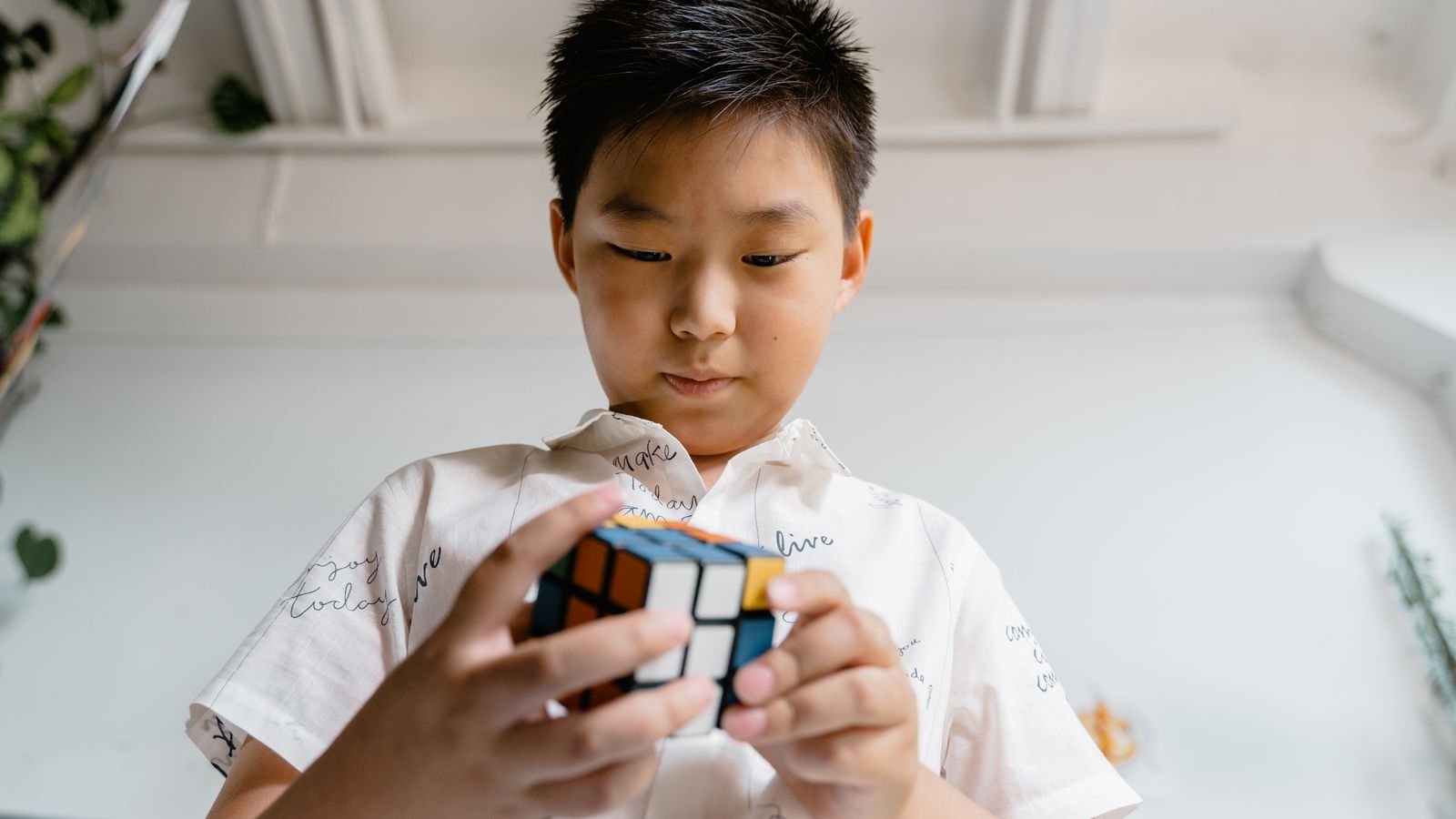
A Rubik’s Cube is one of the few toys that keeps its value for years. Most children meet one, twist it for four minutes, make a mess of it and put it down. A few keep going, and something interesting happens to how they think. The question worth asking is not whether the cube is good for children. It is what exactly it trains, and whether that carries into anything you would actually notice at home.
This guide gives you the honest version. What the research supports, what it does not, and how to help a child get past the first frustrating week, which is where almost everyone stops.
Solving a cube is a planning task disguised as a toy. The child has to hold a picture of the whole cube in mind while only being able to see three faces at once, decide on a sequence of moves before making any of them, carry out that sequence without losing track, and then check whether the result matches what they predicted. That loop, predict then act then compare, is the core of almost every kind of structured thinking a school will later ask for.
The important part is the invisible bit. A child who is genuinely learning is not moving their hands quickly. They are sitting still, turning the cube over, and looking. That pause before the first move is the skill. Everything else is muscle memory.
Spatial reasoning is the ability to picture an object in your head and mentally turn it, and it is the single clearest thing a Rubik’s Cube trains. Very few school subjects teach it directly. Children pick it up sideways, through building, drawing, model making and puzzles, or they do not pick it up much at all.
This matters more than it sounds. A large longitudinal study following around 400,000 American students found that spatial ability measured in adolescence predicted who went into science and engineering careers eleven years later, and it did so on top of verbal and mathematical ability rather than as a substitute for them. In other words, two children with identical maths scores can have very different odds of enjoying physics, and spatial skill is part of the difference.
The encouraging half of the story is that spatial skill is not fixed. A meta-analysis of spatial training studies found that these skills respond to practice and that the gains transfer to tasks the learner never trained on. A University of Minnesota study with eighth grade students used the Rubik’s Cube specifically and found improvements in two and three dimensional mental rotation after training. The cube is not magic. It is simply one of the most engaging spatial workouts a child will voluntarily repeat.
Six things about the cube worth reading aloud at dinner
A standard 3×3 cube has 43,252,003,274,489,856,000 possible arrangements. Only one of them is solved.
In 2010 researchers proved that every single one of those positions can be solved in 20 moves or fewer. Cubers call it God’s Number.
Only around 490 million positions actually require the full 20 moves. Out of 43 quintillion, that is a rounding error.
Erno Rubik, a Hungarian architecture teacher, built the first cube in 1974 to help his students think in three dimensions. The toy came second.
Eighth graders who learned to solve the cube in a university study improved on standard tests of mental rotation.
In a study of roughly 400,000 students, spatial ability in high school predicted STEM careers over a decade later.
The reason a beginner’s method feels difficult is that it loads working memory hard, and working memory is exactly the thing that limits most children in class. A cube algorithm is a short sequence of turns, often six to eight moves, that has to be performed exactly and in order. Miss one, and the cube does not tell you which one you missed. It just looks wrong.
So the child has to keep the sequence in mind, track where they are in it, and hold the goal position separately. That is three things at once, which is roughly the load of a multi-step maths problem. The research on cube solving is careful here: a study on who acquires cube skill fastest found reasoning ability and working memory capacity were the strongest predictors, with personality and grit adding little. That cuts both ways. It means the cube is a real cognitive task, not a gimmick, and it means a child who finds it hard is not failing at being determined.
What changes with practice is chunking. A sequence that started as eight separate instructions becomes one thing the hands know. Once that happens, the working memory that was spent on remembering is freed up for planning. Parents usually notice this as a sudden jump after weeks of nothing.
The most transferable thing the cube teaches is what to do when something goes wrong, because on a cube things go wrong constantly and the damage is never permanent. A child who scrambles their own nearly-finished cube learns, within about 40 seconds, that a mistake is recoverable. There are very few activities where the recovery loop is that short and that visible.
This is why the cube suits distractible children better than parents expect. The feedback arrives immediately, the goal is unambiguous, and each stage is short enough to finish in one sitting. It is also completely offline, which makes it one of the few genuinely absorbing activities that does not involve a screen.
One warning. If the cube becomes a performance, with adults asking for a demonstration every time guests visit, most children quietly stop. Keep it low stakes.
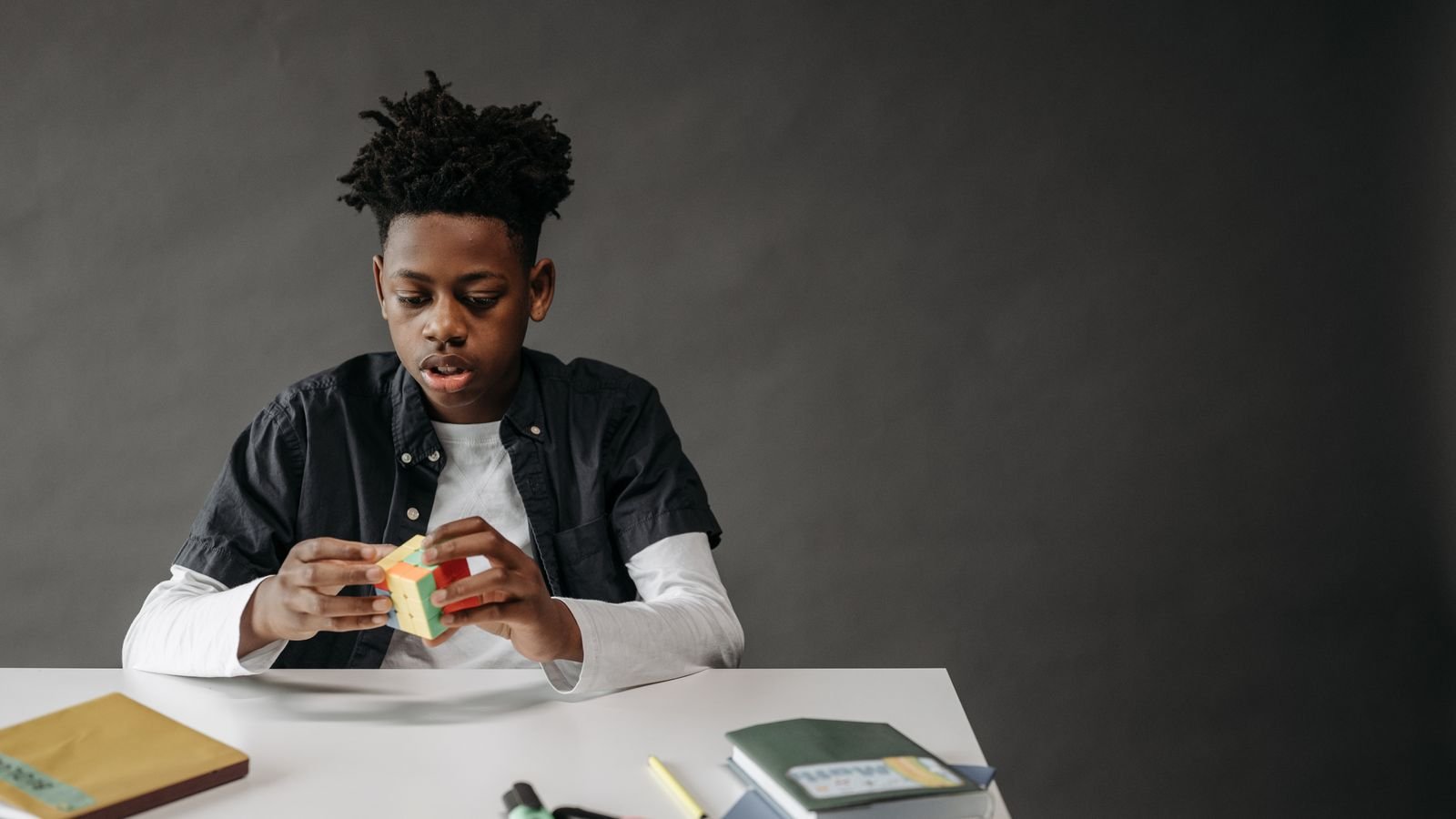
The Rubik’s Cube does not raise IQ, and it will not turn a struggling maths student into a strong one on its own. Any claim that a single hobby rewires general intelligence should be treated with suspicion. General ability is broad and stubborn, and no toy moves it.
What the cube does is narrower and more useful to know honestly. It builds spatial visualisation, sequence memory, methodical working and tolerance for being stuck. Those support school work rather than replace it. A child who cubes for six months will probably find geometry diagrams easier to read and will be more willing to attempt a long problem without giving up at step two. They will not automatically get better at fractions.
Set that expectation early and the cube stays fun. Sell it as a brain upgrade and it becomes homework.
Most children can begin somewhere between six and eight, but what you should expect at each stage is very different. Starting earlier is fine as long as the goal changes with the age.
Ages 4 to 6. Use a 2×2 cube or simply let them play with a 3×3 with no goal at all. At this age the win is colour matching, finger strength and turning smoothly. Do not teach a method. Ask them to make one face all the same colour and stop there.
Ages 7 to 9. This is the sweet spot for the beginner’s layer-by-layer method. Teach one layer, then leave it alone for a week. A child who learns the first layer properly will usually reach a full solve within two to three months of light practice. Trying to teach all three layers in one sitting is the single most common reason children quit.
Ages 10 to 14. Now speed becomes motivating, and that is fine. This is also the age where a child can genuinely understand why an algorithm works rather than just repeating it, which is where the real thinking is. Introduce the idea that some sequences move three pieces while leaving everything else untouched, and many children find that far more interesting than the timer.
Ignore solve times for the first few months and watch for four things instead. First, do they pause and look at the cube before turning it? That is planning appearing. Second, when they get stuck, do they undo their last few moves rather than starting the whole cube again? That is error correction. Third, can they explain a step to you in their own words, not just perform it? Explaining is the clearest sign that understanding has replaced imitation.
Fourth, and most telling, do they pick it up when nobody suggested it? Voluntary practice is the only reliable indicator of long-term progress in any skill. If it is happening, the method is working, whatever the stopwatch says.
Simple things you can try at home this week
Give the cube a home. Leave it on the dining table or next to the sofa, not in a toy box. Cubing is a fidget habit, and habits need the object to be visible.
Scramble small at first. Turn the cube three times, hand it over, and ask them to undo it. Then five turns. Then eight. This teaches reversing a sequence, which is the foundation of everything later.
One layer per week, not one solve per week. Learn the first layer, use it for seven days, then move on. Rushing the full method is why most children abandon the cube in week two.
Ask them to narrate. “Tell me what you are about to do and why.” Saying a plan out loud before executing it is the exact habit you want transferring into maths.
Time nothing for the first month. Stopwatches turn a thinking task into a nervous one. Speed arrives on its own once the method is solid.
Let them teach you. Sit down and be the beginner. Children who teach a step retain it far better, and it removes the feeling of being tested.
Buy a decent speed cube. A stiff, sticker-peeling cube makes a child feel clumsy when the real problem is the hardware. A smooth cube costs very little and removes that excuse entirely.
Try this one with your child. No cube required, though it helps.
Take a solved cube. Turn the right face a quarter turn clockwise. Do it again. And again. And a fourth time. Where is the cube now, and what does that tell you about every sequence of moves?
Tap a question to reveal the answer
Yes, with the expectations set correctly. A Rubik’s Cube is a cheap, portable, screen-free way to train the exact skills that school assumes children already have and rarely teaches directly. It will not transform a report card. It will teach a child to look before acting, to hold a plan in their head, and to treat being stuck as a normal part of solving something rather than a sign to stop.
If your child has picked one up and put it down again, that is the usual pattern, and it is almost always the method that failed rather than the child. One layer, taught properly, changes everything. That is a good hour of teaching, and it is exactly the kind of thing a live 1 on 1 class does well.
More for curious parents
MasterMindz teaches children worldwide through live, personal 1 on 1 online classes in chess, maths, coding, Rubik’s cube, music and languages, with experienced tutors and a fun, individual approach. MasterMindz has taught 750+ students across 11+ countries.