September 28, 2026
A parent scrolling through enrichment options can end up with three tabs open: chess, coding, and the Rubik's Cube. All three are backed by real evidence.


Why the puzzle everyone treats as a party trick is quietly building real cognitive skill.
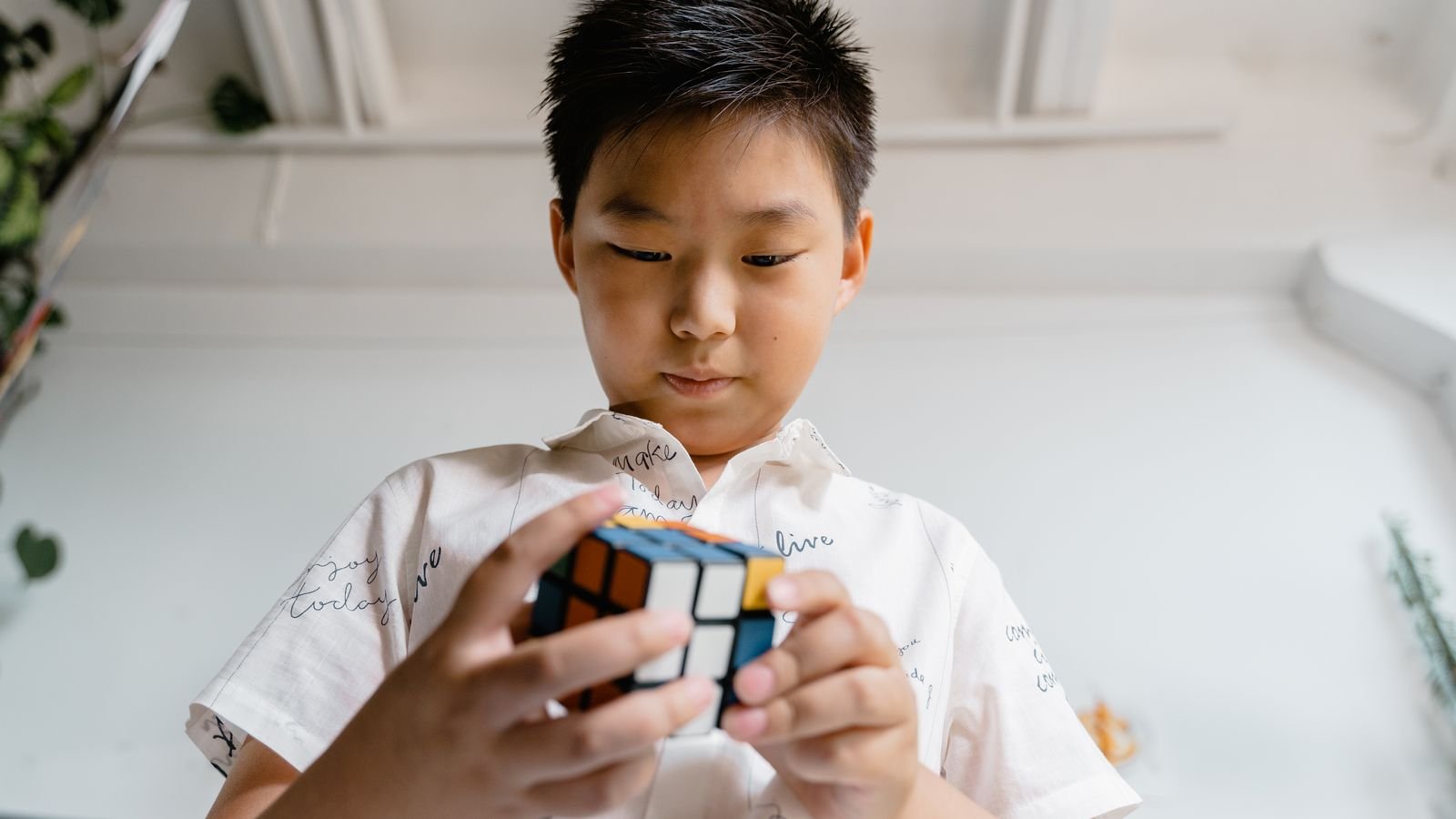
The real value of a Rubik’s cube for a child has almost nothing to do with how fast they can solve it. Speedcubing videos rack up millions of views because a 10-second solve looks impressive, but the skills a child actually builds while learning the cube properly, spatial reasoning, working memory, pattern recognition, and patience under frustration, have very little to do with speed at all.
For parents comparing activities for a child’s free time, the cube is easy to underrate. It looks like a toy. It behaves, cognitively, more like a structured puzzle course that happens to fit in a pocket. Here is what the research actually shows, and how to help a child get the real benefit rather than just memorising a video.
The Rubik’s cube trains a child’s brain to track multiple moving pieces, plan several steps ahead, and adjust calmly when a move does not go as expected. Every twist changes more than one face at once, so a child has to hold a mental picture of the whole cube, not just the piece in front of them, which is a very different skill from most toys that only respond to a single, local action.
Spatial reasoning is the ability to picture how an object looks and moves in three dimensions without actually seeing it happen, and it is one of the more reliable predictors of later achievement in maths, science, and engineering. Researchers at the University of Minnesota studied this directly with the cube itself. In a paper on supporting middle school students’ spatial skills through Rubik’s cube play, structured cube practice was linked to measurable gains in students’ spatial ability, the exact skill set that later shows up in geometry, physics, and technical subjects.
Learning the cube properly means holding a short sequence of moves in mind, applying it, and checking the result, which is the same working-memory muscle a child uses for mental maths and multi-step word problems. A child who has never practised holding several steps in mind at once often struggles with instructions like “carry the 1, then subtract, then check your answer,” not because the maths itself is hard, but because tracking the sequence is unfamiliar. Cube practice, done slowly and by understanding rather than pure repetition, builds exactly that sequencing muscle in a low-stakes, genuinely fun way.
Six surprising facts about the cube most parents haven’t heard
Beginners memorise a fixed sequence, but advanced solvers understand the underlying logic well enough to solve any scramble from scratch.
A standard 3×3 cube has roughly 43 quintillion possible scrambles, yet every single one can be solved in 20 moves or fewer.
Solving builds bilateral coordination, using both hands together in a precise, patterned way rather than one hand doing all the work.
The cube cannot be rushed or guessed through. Children learn to stay with a problem through several failed attempts before it clicks.
Spatial skill measured in the middle school years is linked to later achievement in maths, science, and engineering subjects.
Children as young as 5 or 6 can learn simple layer-by-layer methods. No advanced maths is needed to begin.
Beyond the Minnesota spatial skills study, a broader statistical analysis of the cube’s classroom impact, published in the IOSR Journal of Mathematics, found consistent links between regular cube practice and improved problem-solving performance among students who practised it over time. The pattern across this research is the same: it is not exposure to the cube that matters, it is structured, repeated practice with genuine understanding of the method, which is very different from watching a solve video once and putting the cube in a drawer.
Understanding should always come before speed, because a child who only memorises a fast algorithm without knowing why it works gets stuck the moment they forget a step and has no way to recover. A child who understands the logic of the cube can always work their way back to a solve, slowly, even after a long break. Speed is a fun goal to chase later. It should never be the first goal, because chasing it early is exactly what turns the cube into rote memorisation instead of genuine problem solving.
Solving a Rubik’s cube is, at its core, following an algorithm: a fixed sequence of steps applied in order to reach a specific goal, which is exactly what a line of code does. Children who learn to break the cube into stages, corners first, then edges, then the final layer, are practising the same “divide the big problem into smaller steps” thinking that shows up constantly in both coding and multi-step maths problems. Many parents notice their child’s approach to tricky maths homework becomes calmer and more methodical after a few months of regular cube practice, even though the two subjects look completely unrelated on the surface.
The most common mistake is expecting speed too soon, which turns a fun puzzle into a source of frustration before the basics are even solid. A close second is leaving a child to figure out the whole solve alone from a video, which works for some children but leaves many stuck and quietly discouraged at the exact same step for weeks. The fix for both is the same: a patient guide who can see precisely which stage is confusing and slow down there, rather than a one-size-fits-all tutorial that keeps moving regardless.
Simple things you can try at home this week
Start with a beginner layer-by-layer method. Skip speedcubing algorithms until the basics are solid and understood.
Practise one face at a time. Mastering the white cross before moving on builds confidence in small, visible wins.
Save the timer for later. Introduce timing only once your child can solve it comfortably without one.
Have them teach you the solve. Explaining a method out loud is one of the fastest ways to cement real understanding.
Try a “scramble of the week.” A short, low-pressure ritual keeps practice consistent without feeling like homework.
Let them get stuck for a bit. A few minutes of productive struggle before help arrives builds real problem-solving stamina.
Try a free trial class. A live tutor can see exactly which stage is confusing your child and adjust in real time, something a video cannot do.
A classic cube logic puzzle, no cube required
On a standard Rubik’s cube, white and yellow are always opposite each other, and so are red and orange, and blue and green. If white is facing up and green is facing you, which colour is on the bottom?
Tap a question to reveal the answer
The cube rewards patient, structured practice far more than it rewards talent, which makes it one of the more accessible ways to build real cognitive skill in a child who enjoys hands-on challenges. A live 1 on 1 online Rubik’s cube class gives a child that structure with a tutor who notices exactly where they get stuck. A free trial class is a simple, no-cost way to see how your child takes to it.
MasterMindz teaches children worldwide through live, personal 1 on 1 online classes in Rubik’s cube, chess, maths and more, with experienced tutors and a fun, individual approach.