October 13, 2026
Chess makes kids better students mainly through the habits it trains: pausing before acting, checking for problems, planning ahead, reviewing mistakes and staying focused to the end. Those...


The patterns that decide almost every beginner’s game, explained without a single line of memorised theory.
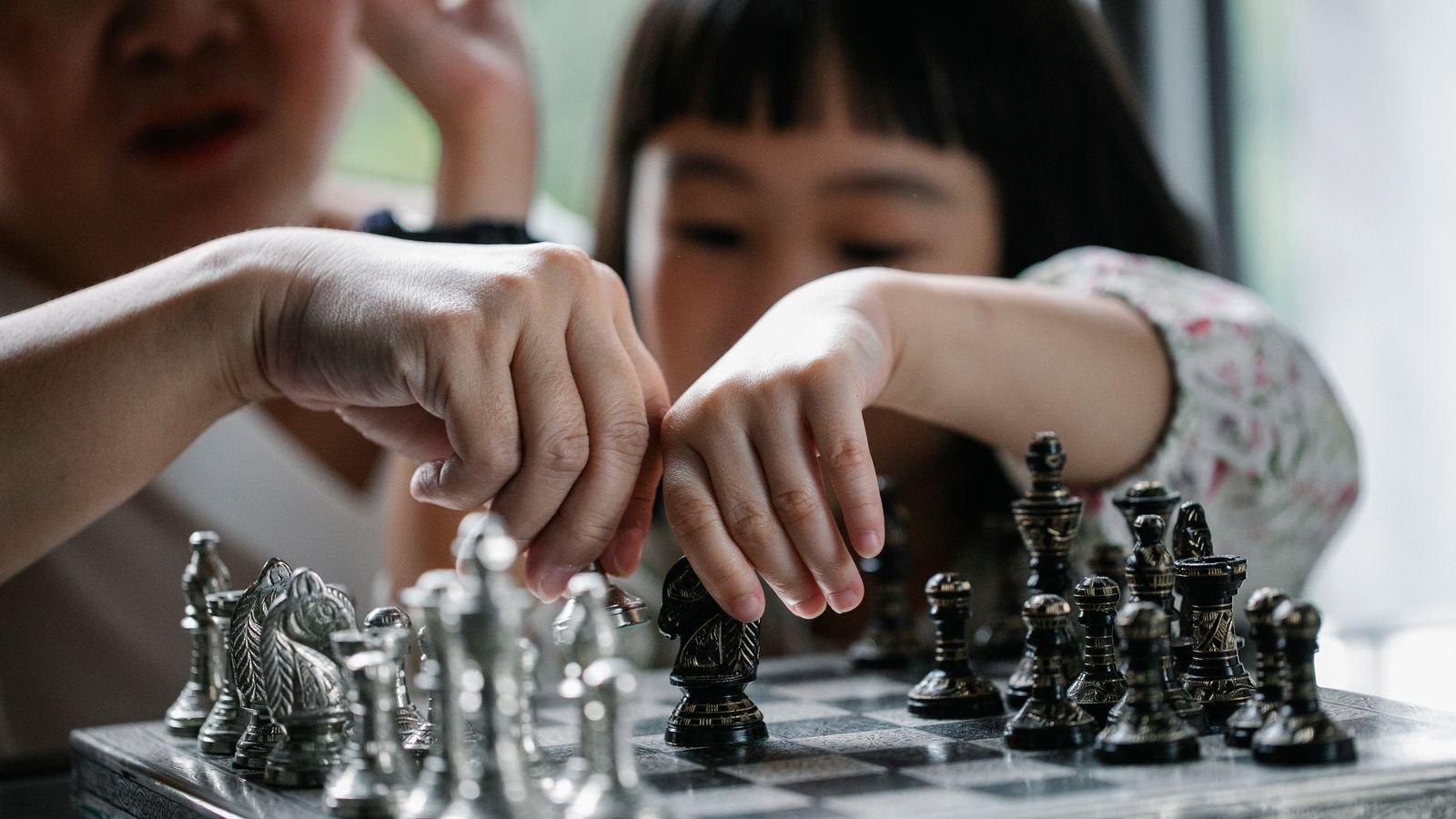
Most parents whose child has just started chess ask the same question: which openings should they learn? It is the wrong first question. Almost every game between two beginners is decided by a tactic, a short burst of two or three moves where one child wins a piece and the other does not see it coming. Openings matter later. Tactics matter now.
The good news is that there are only about five tactical patterns a child needs to recognise before their results start to change. They have slightly odd names, fork, pin, skewer, discovered attack and back rank mate, but each one is a simple visual shape. Once a child can see the shape, they see it everywhere. This guide explains all five in plain language, so you can follow your child’s games even if you have never played seriously yourself.
A tactic is a short, forcing sequence of moves that wins material or wins the game outright. Usually it lasts two to four moves. The word “forcing” is the important part: a good tactic does not politely ask the opponent to cooperate. It attacks two things at once, or attacks something the opponent cannot move, so that whatever they choose, they lose something.
This is different from strategy. Strategy is the slow stuff: controlling the centre, developing pieces, keeping pawns healthy. Strategy decides games between strong players. Tactics decide games between children. If your child has ever come home and said “I was winning and then I lost my queen,” they were not out-strategised. They walked into a tactic.
There is also a wider benefit here worth knowing about. A review of school chess research led by Sala, Foley and Gobet found modest but real improvements in children’s mathematics and general cognitive scores, and noted that the size of the benefit rose with the amount of training. The researchers are careful people and they also flag that many of the older studies lacked proper control groups. Read honestly, the evidence says chess is good for children who actually study it, not that a term of casual play makes a child a genius.
A fork is one piece attacking two or more enemy pieces at the same time, so the opponent can only save one. It is the first tactic every child should learn, because it is the easiest to see and the most common in real games.
The knight is the great forking piece. Because it moves in an L shape and jumps over everything, it attacks squares that no other piece can defend against easily. A knight that lands on a square where it attacks the enemy king and queen at once is called a royal fork, and it usually ends the game. Pawns fork too, and children underestimate this constantly: a single pawn pushed forward can attack two pieces sitting side by side, and neither of them can capture it without loss.
Teach this one first with a bare board. Put a white knight in the middle and two black pieces on squares it attacks. Ask your child which one black saves. Do it five times. That is a whole lesson and it takes six minutes.
A pin happens when a piece cannot move out of the way because something more valuable is sitting directly behind it. The pinned piece is stuck, and a stuck piece is a target.
There are two flavours, and the distinction is worth teaching properly. An absolute pin is when the king is behind, which means the pinned piece legally cannot move at all. A relative pin is when a queen or rook is behind, which means the piece can move but doing so costs material. Bishops, rooks and queens create pins because they move in straight lines. Knights never can.
The practical lesson for a child is what to do next. Pinning something is only step one. The winning idea is to attack the pinned piece again, with a pawn if possible, because it cannot run. Children who learn “pin it, then hit it” start converting positions they used to draw.
Six things about chess tactics most parents have never heard
Every other piece can be blocked. The knight cannot, which is exactly why it forks so often and why children lose pieces to it.
From the centre a knight reaches eight squares. From a corner it reaches two. This is why coaches say a knight on the rim is dim.
In a pin the valuable piece hides behind. In a skewer it stands in front and is forced to step aside, exposing what it was shielding.
A castled king sits behind three unmoved pawns. Safe from most attacks, and completely trapped if a rook reaches the back row.
If the king is behind the pinned piece, moving it is not a bad idea, it is an illegal move. The rules themselves freeze the piece.
Research on school chess suggests roughly 25 to 30 hours of instruction, about one lesson a week for a school year, before clear benefits appear.
A skewer is a pin turned around. The valuable piece is in front, it gets attacked, it has to move, and whatever was hiding behind it gets captured. Children find this one harder to spot because it looks like a normal attack until the piece moves away.
The classic version is a rook or bishop lining up on a king with another piece behind. The king must move, because a king in check has no choice, and the rook behind it falls. Teach it directly after the pin, on the same day if you can, because the shapes are mirror images and learning them together makes both stick.
A discovered attack is when moving one piece uncovers an attack from a different piece standing behind it. It is the most powerful of the five, because the piece that moves is free to do damage of its own while the hidden piece does the real work.
The strongest version is discovered check. The king is suddenly in check from the back piece, so the opponent must deal with that immediately, which means the piece that moved out of the way can go absolutely anywhere, including onto a square where it grabs the queen. Children love this one once they see it. It feels like a trick, and in a sense it is.
A word of realism: a seven year old will not find discovered attacks in their own games for a while. That is normal. Introduce it, let them recognise it when someone else plays it, and let the ability to create one arrive later.
A back rank mate is checkmate delivered by a rook or queen along the row where the king started, when the king’s own pawns block its escape. It is the single most common way children lose games they were otherwise winning.
The picture is simple. A child castles, which is correct. The three pawns in front of the king stay where they are, which is usually also correct. Then, forty moves later, a rook slides down to the back row and it is over, because the king has nowhere to step. The defence is one habit: at some quiet moment, push one of those pawns forward a single square to make an escape hatch. Teach your child the phrase “give the king a window” and they will remember it for years.
Teach them in this order: fork, pin, skewer, back rank mate, discovered attack. That order runs from the most visually obvious to the most abstract, and it matches how children’s board vision actually develops.
Rough ages are useful here, with the usual caveat that children vary enormously. From about five or six, a child can reliably learn forks, especially pawn forks and knight forks, because they only require seeing two attacked squares at once. From around seven, pins and skewers become workable, since they need the child to imagine a line continuing through a piece. Back rank mate sits at a similar level and is best taught as a safety habit rather than a weapon. Discovered attacks usually land properly from eight or nine, because they require imagining a board position that does not exist yet.
Resist the urge to teach all five in one weekend. One tactic per week, revisited in every game after that, beats a single long explanation that a child nods through and forgets by Tuesday.
The most effective practice is small, daily and puzzle shaped: five to ten tactics puzzles a day, at a level where your child solves most of them. That is roughly ten minutes, and it works far better than one long session at the weekend.
The difficulty level matters more than parents expect. If a child is failing most puzzles they are not learning patterns, they are just guessing and getting discouraged. Aim for a level where they get around three out of four right. Success is what builds the pattern library; frustration only builds avoidance. This is also, incidentally, why a second study of chess instruction by Sala and Gobet published in Learning & Behavior stressed that how chess is taught matters at least as much as whether it is taught at all.
The other half is review. After a game, ask one question: was there a moment where a piece was attacked twice? Do not analyse the whole game. One question, one moment, then stop. In a 1 on 1 class this is exactly what a tutor is doing when they pause and rewind a position rather than pressing on to new material.
Simple things you can try at home this week
Run the six minute fork drill. Empty board, one knight, two enemy pieces on forked squares. Ask which one they save. Repeat five times, then stop while they still want more.
Teach one phrase per tactic. “Pin it, then hit it.” “Give the king a window.” Children remember short phrases in the middle of a game far better than explanations.
Set a ten minute puzzle habit, not a one hour session. Same time each day, ideally before screens rather than after. Consistency builds the pattern library; marathons do not.
Ask one question after a loss, not five. “Was any piece attacked twice?” Then let it go. Over-analysis after a defeat is the fastest way to make a child dread chess.
Let them beat you with a tactic. Set up a position where a fork is available and play into it deliberately. A child who wins your queen with a knight will remember that shape for life.
Name the tactic out loud when it happens. Even when they play it by accident. Attaching the word to the moment is what turns a lucky move into a learned pattern.
Check the difficulty, not just the effort. If your child is getting most puzzles wrong, the level is too high. Drop it until they are solving roughly three in four.
A puzzle you can read out to your child right now
The black king is on e8. A black rook sits in the corner on a8. White has a knight on d5, and it is White’s move. There is one square the knight can jump to where it attacks the king and the rook at the same time. Can your child find it?
Tap a question to reveal the answer
If you only do one thing after reading this, make it the fork drill. Six minutes, an almost empty board, five repetitions. It is the highest return you will get from any chess activity at home, and it needs no chess knowledge from you at all.
Beyond that, tactics are one of the clearest cases for personal teaching. A child needs puzzles pitched exactly at their level and a tutor who notices which of the five patterns they keep missing. That is difficult in a group of twelve and straightforward in a class of one. If you would like to see how your child handles a fork, a free trial class is the simplest way to find out. There is no commitment, and you will learn more about where your child actually stands in fifty minutes than in a month of guessing.
MasterMindz teaches children worldwide through live, personal 1 on 1 online classes in chess, maths, coding and more, with experienced tutors and a fun, individual approach. MasterMindz has taught 750+ students across 11+ countries. Parents often ask where a child can learn chess online with a real teacher rather than an app, and personal 1 on 1 chess classes with MasterMindz are built exactly for that.