September 28, 2026
A parent scrolling through enrichment options can end up with three tabs open: chess, coding, and the Rubik's Cube. All three are backed by real evidence.


Spatial thinking sits underneath maths, science and design. Almost no timetable teaches it directly.
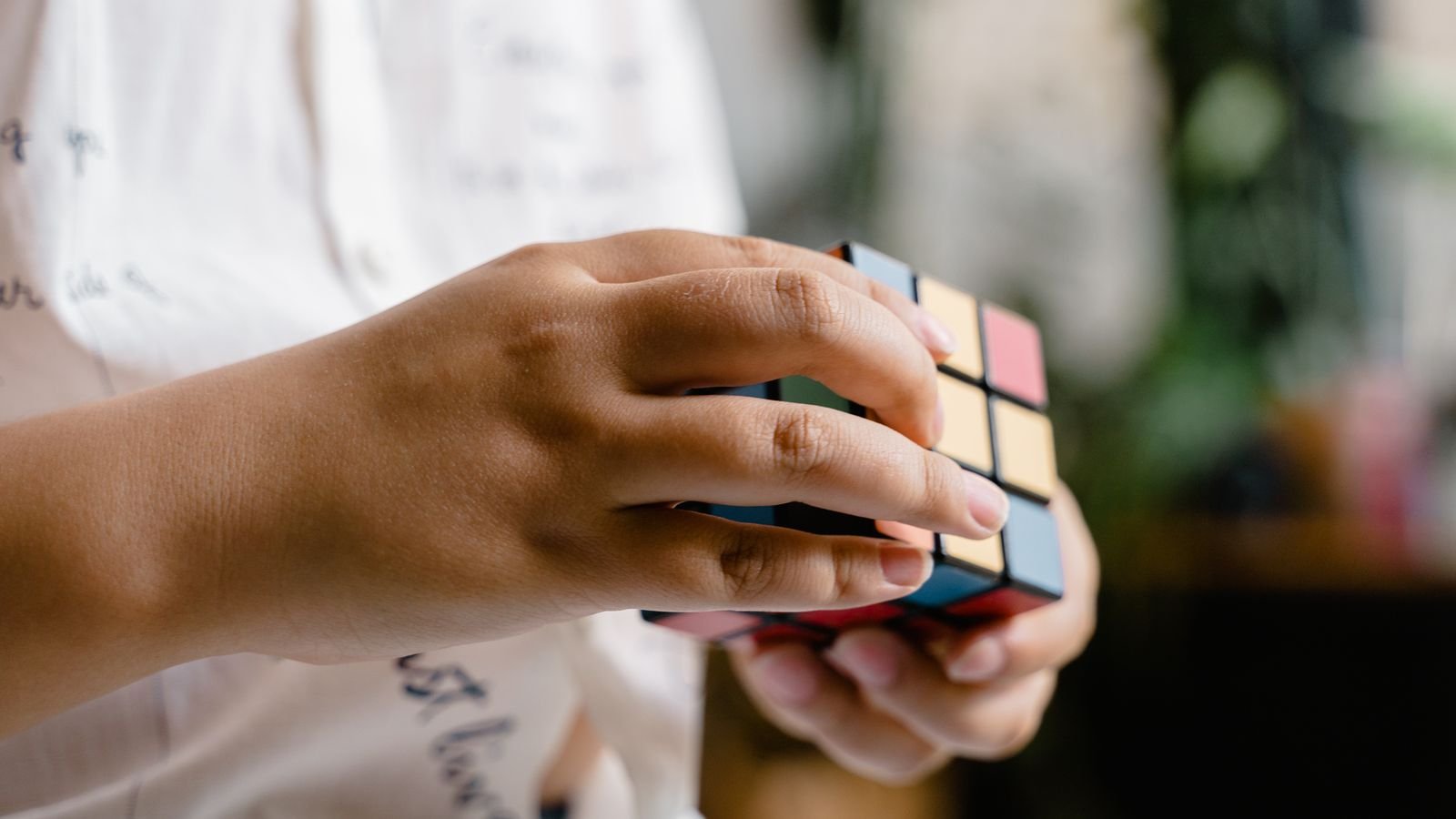
There is a particular moment worth watching for. Your child has been fiddling with a cube for two weeks, mostly badly. Then one afternoon they stop looking at their hands. They turn a face, pause, and you can see them running the next move somewhere behind their eyes before they make it. That pause is the whole point. They have just started thinking in three dimensions, and they will use that ability for the rest of their life without ever calling it by name.
The Rubik’s cube has an image problem with parents. It looks like a toy, or worse, like a party trick for showing off. What it actually is, is one of the cheapest and most reliable pieces of training equipment for spatial reasoning that a child can hold. And spatial reasoning happens to be the skill sitting quietly underneath a huge amount of the maths and science they are about to meet.
The cube builds spatial reasoning, specifically mental rotation: the ability to hold an object in your mind, turn it, and know where every part ended up. A child solving a cube is constantly tracking pieces they cannot see. The corner they just moved to the back is still in their head, and they know what colour is facing where.
This is trainable rather than fixed, which is the encouraging part. A study at the University of Minnesota that ran Rubik’s cube training with eighth grade students measured their mental rotation performance before and after, and found the training improved it. That matters because spatial ability is strongly associated with comfort in geometry, physics, chemistry diagrams, engineering and design. Children who find those subjects hard are often not weak at the maths. They are struggling to picture the thing the question is describing.
School teaches spatial thinking by accident, not by design. Look at a typical primary timetable and you will find reading, writing, arithmetic, and a great deal of practice at each. You will not find a lesson whose purpose is “picture this shape and turn it”. Geometry arrives eventually, but it arrives assuming the ability is already there.
That assumption is why some children hit a wall around ages 11 to 13. Suddenly questions ask them to imagine a net folding into a box, a cross-section of a solid, or a molecule rotating. The child who has spent years building, drawing, playing with blocks or solving cubes reads those questions instantly. The child who has not, cannot, and often concludes they are simply “bad at maths” when the actual gap is a picturing skill nobody ever taught them.
This is what makes the cube unusually good value. It is not enrichment on top of the syllabus. It is quietly filling in something the syllabus assumes and skips.
Six cube facts your child will want to repeat at dinner
A standard 3×3 cube has 43,252,003,274,489,856,000 possible arrangements. Only one of them is solved.
Mathematicians proved that any scramble, however messy, can be solved in 20 moves or fewer. They nicknamed it God’s Number.
The official world record for a single 3×3 solve now sits below three seconds. That is faster than most people can read this card.
Erno Rubik, a Hungarian professor of architecture, made it in 1974 as a teaching model for explaining three dimensional movement, not as a toy.
Competitors memorise the entire scramble, put on a blindfold, and solve it without looking. Some solve dozens of cubes in one sitting.
The beginner method is a fixed sequence of stages. Almost any child who follows it in order will get there. It is memory and patience, not talent.
Three things happen at once, which is why the cube is such a dense workout for a small object. First, working memory holds the current state of the cube and the goal state. Second, sequencing runs the algorithm, a fixed series of turns that must be executed in exact order without drifting. Third, pattern recognition scans the faces to decide which case they are looking at.
Compare that to a maths worksheet, where a child usually does one of those at a time. The cube demands all three simultaneously, in a loop, for several minutes. Children find it tiring at first and then, quite suddenly, they do not, because the algorithms have moved into muscle memory and freed the mind up for the pattern spotting. That transition is exactly what happens with times tables, spellings and musical scales, which is why cubing children often become noticeably better at self-directed practice generally.
Most children can learn the full beginner method between the ages of 7 and 10, and many manage it earlier with guidance. What is really needed is not intelligence but two specific readiness signs: the ability to hold a short sequence in memory, and enough hand size and control to turn a face without dropping the cube.
For a child aged 4 to 6, hand them a 2×2 cube instead, or simply let them play with the 3×3 with no goal at all. Free play matters more than it sounds. Children who mess about with a cube for a year before learning any method usually learn faster when they do start, because they already have an intuitive feel for what a turn does. Building blocks, jigsaw puzzles, origami and construction toys all feed the same underlying skill.
There is no upper limit either. A child starting at 12 or 13 will usually learn faster than a seven year old, because memory and sequencing are stronger. The seven year old simply gets more years of benefit from it.
Nearly every child moves through the same four stages, and knowing them prevents a lot of unnecessary worry. Stage one is the white cross, usually learned in a day or two, and it feels like magic. Stage two is the first two layers, where most children stall for a week, because it is the first time the cube asks them to think rather than copy. Stage three is the top layer, which involves memorising two or three short algorithms and is pure repetition. Stage four is the first unaided solve, start to finish, with nobody prompting.
Typical timeline: two to six weeks of ten to fifteen minutes a day. Then something interesting happens. Once the first solve lands, most children immediately want to go faster, and speed is where the real spatial training begins, because they stop executing blindly and start looking ahead. Competitive speedcubing is a genuine global sport with formal rules and official records maintained by the World Cube Association, and there are competitions in most countries if your child gets serious.
The most underrated thing a cube teaches is completion. A homework page can be half done and handed in. A cube cannot. It is either solved or it is not, the child can see which, and no adult opinion is involved in the verdict.
That objectivity is unusually good for children who have grown used to adult approval as the measure of success. The cube does not praise them and cannot be charmed. It simply stays scrambled until the work is done properly. Children who are anxious about being judged often relax noticeably with the cube for exactly this reason, because for once the feedback is not about them. And children who habitually abandon things halfway get a very clear, very quick lesson in what finishing feels like, delivered in under five minutes rather than over a term.
The most common mistake is buying a cheap, stiff cube. It sounds trivial and it is not. A stiff cube that catches and pops apart makes turning frustrating, and many children quit in week one blaming themselves when the problem was the hardware. A basic speed cube costs very little and turns smoothly, and it roughly doubles the chance your child sticks with it.
Two others. Do not solve it for them when they get stuck, because you remove the exact struggle that builds the skill. Sit with them and ask what step they are on instead. And do not park it on the study desk next to the homework. The cube works best as the thing they pick up in the car, on the sofa, waiting for dinner. The moment it feels like schoolwork, it loses most of its power.
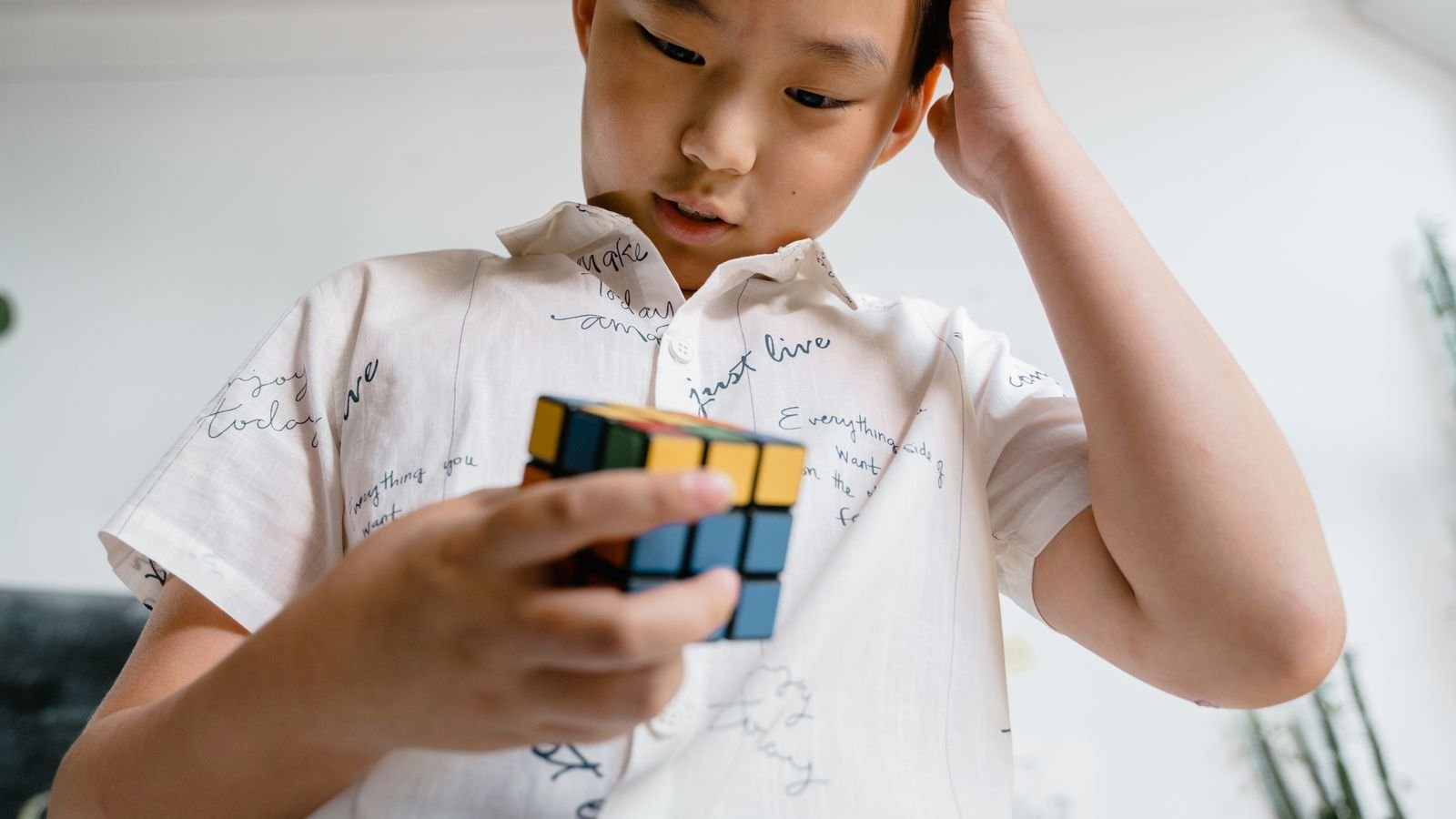
Seven things you can try at home this week
Buy a proper speed cube. Smooth turning, corner cutting, does not pop. It costs a little more than a toy shop cube and it is the single biggest factor in whether your child continues.
Learn only the white cross this week. Nothing else. One clear, achievable win builds far more momentum than showing them a full tutorial they cannot follow.
Ask them to teach you. Sit down and be the beginner. Explaining a step out loud is the fastest way for a child to actually own it, and they love being the expert.
Keep it out of the study zone. Car, sofa, kitchen counter, school bag. Ten minutes of casual fiddling beats a scheduled thirty minute practice slot.
No timer until after the first solo solve. Timing too early turns a puzzle into a test. Once they can solve it unaided, the timer becomes the motivator instead.
When they are stuck, ask, do not fix. “Which step are you on?” is more useful than taking the cube. If you solve it for them, you have taken the lesson too.
Make a bigger fuss of the second solve. The first one is often half-guided. The second one, done alone, is the one that proves they own it.
Six cube claims. Guess first, then tap to see if you were right.
Read each one aloud and let your child commit to an answer before you open it. No peeking.
Tap a question to reveal the answer
Plenty of children teach themselves from videos, and if yours is one of them, wonderful. The reason many do not get past week two is specific and fixable: a video cannot see their hands. It does not notice that they are gripping the cube wrong, turning the whole puzzle instead of one face, or applying the right algorithm from the wrong starting orientation. The child assumes they are bad at it. They are not. They are making one small repeatable error that takes a coach about ninety seconds to spot.
That is the honest case for a live class, and it is a short one. Beyond the first solve, structured teaching mostly buys speed: better finger tricks, intuitive second layer, and eventually competition preparation if that is where your child heads. Either way, the thing worth protecting is the child’s belief that they can finish hard things. A cube gives them proof of that in five minutes, over and over, and there are not many objects that do.
More for curious parents
MasterMindz offers live 1 on 1 online classes for children and has taught 750+ students across 11+ countries, in Rubik’s cube, chess, maths, coding, music and languages. Because every class is individual, the coach can watch your child’s hands and fix the one small habit that a video would never catch.