September 28, 2026
A parent scrolling through enrichment options can end up with three tabs open: chess, coding, and the Rubik's Cube. All three are backed by real evidence.


It is not a memory trick. It is the first proper thinking tool most children ever hold.
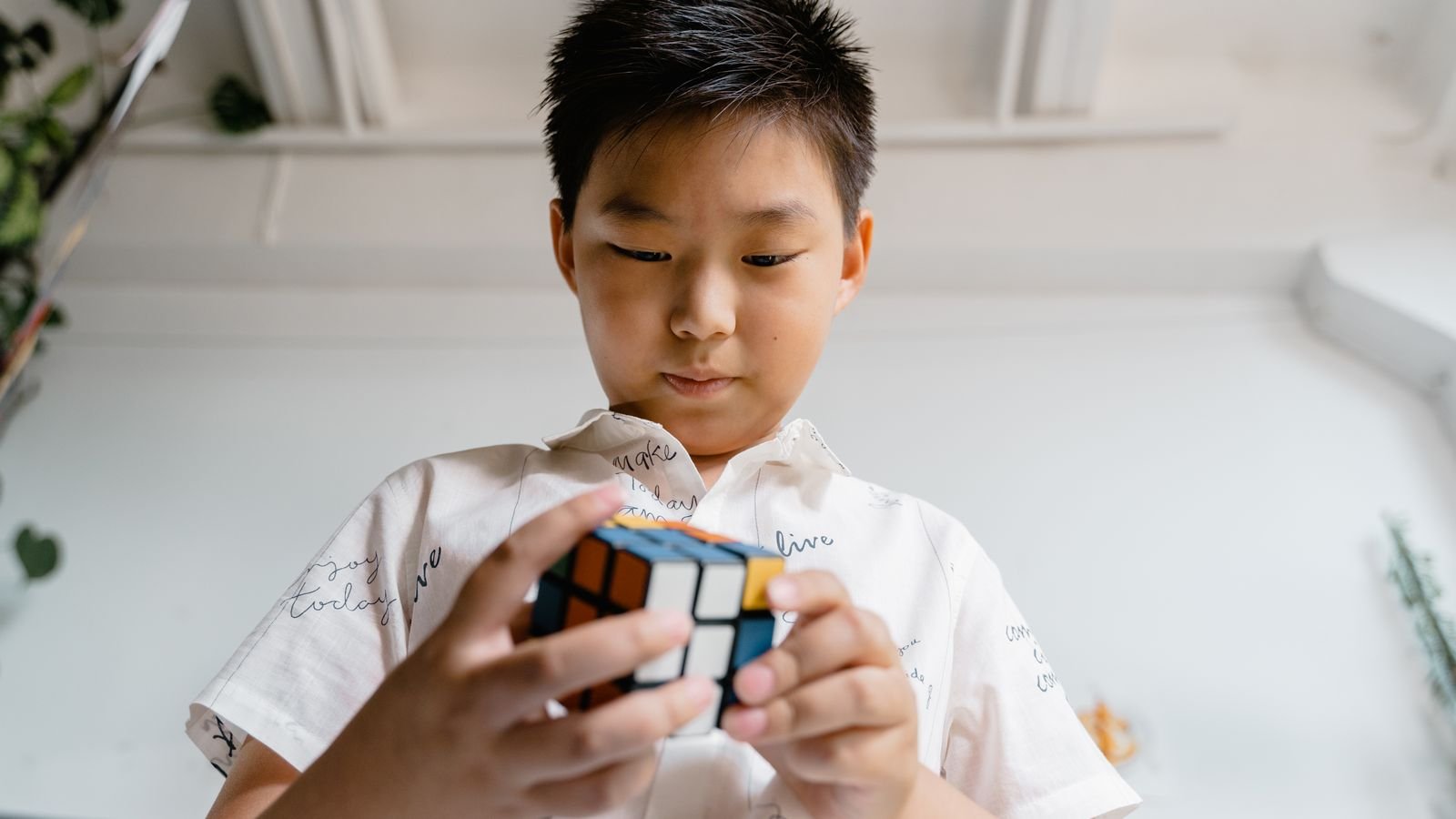
Most parents see the Rubik’s Cube as a clever toy. A child fiddles with it, colours shuffle around, and after a few frustrated minutes it goes back on the shelf next to the half-built Lego. That view is understandable, and it is also almost exactly wrong.
The cube is one of the few objects a child can hold that forces them to think several steps ahead about things they cannot see. That is an unusual demand, and it is the reason educators keep coming back to it. What follows is an honest look at what a child actually gains from learning to solve one, what the research supports, and what it does not.
Solving a Rubik’s Cube teaches a child four specific things: to hold a picture in their head and rotate it, to follow a sequence precisely, to plan a move that temporarily makes things look worse, and to keep going after a mistake. None of those are chiefly about colours or speed.
The third one is the most interesting and the least obvious. To place a corner piece correctly, a child often has to break up a section they have already solved, run a short sequence, and rebuild it. Every young solver hits this moment and every young solver hates it. Learning that a temporary step backwards can be part of a correct plan is a genuinely difficult idea, and children who internalise it through a cube carry it into maths problems, essays and eventually life.
The fourth is quieter still. A cube gives instant, unarguable feedback. It is either solved or it is not. There is no partial credit and no teacher’s opinion to negotiate with. Children find this oddly comforting, and it builds a very healthy relationship with getting things wrong.
Spatial reasoning is the ability to picture objects and mentally rotate them, and it is one of the better predictors of later achievement in science, technology, engineering and mathematics. A landmark longitudinal study from Vanderbilt University tracked around 400,000 students over more than a decade and found that spatial ability measured in adolescence kept showing up among those who later earned advanced qualifications and careers in STEM fields, even after accounting for maths and verbal scores.
Here is what makes that relevant. Spatial ability is trainable. It is not a fixed gift a child either has or does not have. Research at the University of Minnesota gave a group of middle school students structured Rubik’s Cube training sessions and measured their mental rotation ability before and after, finding measurable improvement in both two and three dimensional rotation tasks.
Be careful with how far you stretch this, though. Learning to solve a cube will not automatically raise your child’s maths grade next term, and anyone who promises that is overselling. What it does is exercise a specific mental muscle that maths and science lean on heavily. Think of it as strength training rather than a shortcut.
Six facts about the cube worth telling your child tonight
A standard 3×3 cube has about 43 quintillion possible arrangements. Written out, that is 43 followed by 18 zeros, and only one of them is solved.
Mathematicians proved in 2010 that any scrambled cube can be solved in 20 moves or fewer. They nicknamed this number God’s number.
Erno Rubik invented the cube in 1974 and then could not solve it. It reportedly took him about a month to work out how his own creation went back together.
The official single-solve world record now sits at just over three seconds. A sneeze takes longer than that.
Competitive cubing has official categories for solving one-handed and blindfolded. Blindfolded solvers memorise the whole cube first, then never look again.
The beginner method most children learn needs only about six or seven short move sequences. Everything else is knowing when to use which one.
The Rubik’s Cube works because it delivers problems in exactly the right size for a child’s attention span. Each stage, the white cross, the first layer corners, the middle edges, gives a small clear goal that takes a few minutes and ends in a visible win. Then the next one starts.
Compare that to a maths worksheet, where a child may work for twenty minutes before finding out whether any of it was right. The cube tells them immediately. That rhythm of small goal, effort, visible result is what keeps children turning it long after they would have abandoned a puzzle book, and it is why cubing habits tend to stick.
There is also something useful in the fact that it is physical. A child holds it, turns it, hears it click. For children who struggle to sit still with a book, a puzzle they can fidget with while thinking is not a distraction from learning. It is the thing that makes learning possible.
Most children are ready to learn the standard 3×3 cube from around age 6 or 7, and with two or three short practice sessions a week they typically get their first full solve within 4 to 8 weeks. Some manage it faster. Very few take longer if the teaching is structured.
Age is less useful as a test than two other signals. Can your child follow a four-step instruction without losing the thread? And can they cope with something they had almost finished falling apart? If both answers are yes, they are ready, whether they are six or eleven. If your child is four or five and keen, let them play with the cube freely and learn to make patterns. Formal solving can wait a year and will go far better for the delay.
One caution worth naming. The first two weeks are the hardest, because nothing looks like progress yet. A child learning alone from a video often quits precisely here. This is the single biggest reason a guided class outperforms self-teaching for young children: not because the method is secret, but because someone experienced is there during the week where it stops being fun.
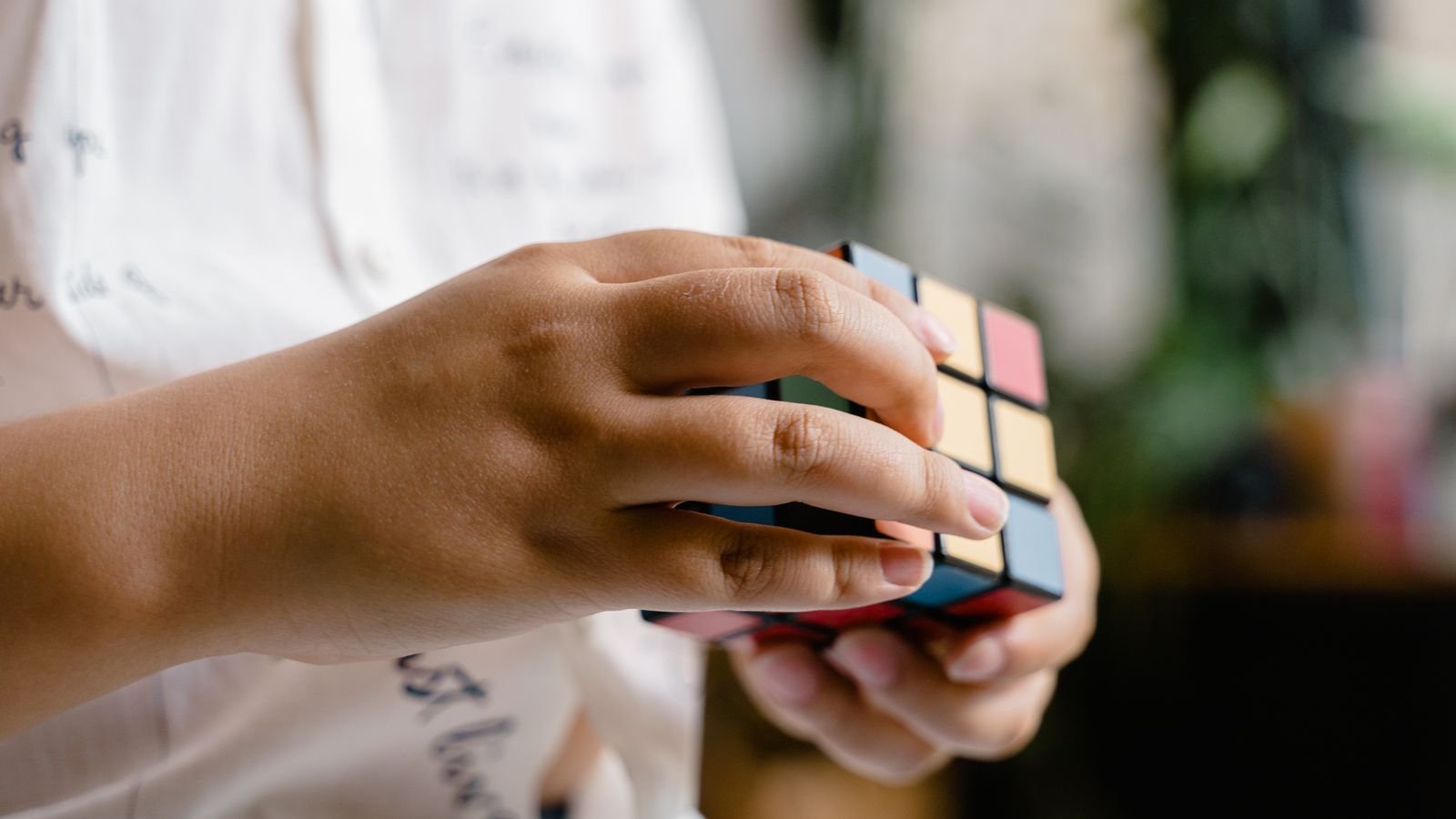
The move sequences a child learns for the cube are algorithms in the exact sense a programmer uses the word: a fixed set of steps that reliably produces a known result. This is not a loose analogy. It is the same idea, arriving five years before their first coding class.
Watch what a child does once they know two or three sequences. They start recognising which situation they are in, choosing the right sequence for it, and applying it. That is conditional logic. When they repeat a sequence until a piece lands correctly, that is a loop. When they realise a sequence works no matter which face they hold at the front, they have discovered that a procedure can take an input. Children do not know these names, and it does not matter. The mental shape is already forming.
This is why parents who are hoping to nudge a child towards coding often get further with a cube than with an app. The cube teaches the thinking. The syntax can come later and takes a fraction of the time once the thinking is there.
The cube’s most valuable lesson is emotional rather than cognitive: it teaches a child that being stuck is a normal stage, not a verdict on their intelligence. Very few school activities teach this, because school tends to reward children who already know the answer.
Every child who learns to solve a cube will, at some point, be one layer from finished and then destroy it with a wrong turn. What happens next is the actual education. The first few times there will be frustration and possibly a cube thrown across a room. Within a month, most children shrug, scramble it, and start again. That shift is worth more than the solve itself.
Parents can help enormously here by being careful what they praise. Praise the restart, not the finish. “You got stuck and you tried a different way” is a sentence that builds a persistent child. “You are so clever” is a sentence that quietly teaches them to avoid anything hard, in case it turns out they are not.
The most common mistake is buying a cheap, stiff cube. A poorly made cube catches, locks up and needs real force to turn, which makes a child think they are failing when actually the toy is. A reasonable speed cube costs very little and turns smoothly, and it changes the experience completely. This one purchase decision matters more than most parents expect.
The second mistake is putting a solution video on and walking away. Children can follow along and produce a solved cube without understanding a single thing, and they will not be able to repeat it. Watching a video is not learning; being asked to explain why a move works is.
The third is treating speed as the goal from day one. A child who is timed too early learns to rush and stops thinking. Let them solve slowly and correctly for at least a few weeks. Speed arrives on its own and always sooner than parents expect.
No, speed is not where the benefit lives. Almost everything valuable about cubing happens during the slow, uncertain part: the visualising, the planning, the recovering from mistakes. Once solving becomes fast it has largely become muscle memory, which is impressive to watch but is a different mental process altogether.
That does not mean speedcubing is pointless. Competitions give children a goal, a community and a reason to keep practising, and there is real joy in shaving five seconds off a personal best. Just do not confuse the trophy with the training. A child who solves in ninety seconds and thinks the whole way through is getting more out of it than one who solves in twenty and is no longer thinking at all.
If your child does catch the competitive bug, follow it. Official competitions run in most major cities, they are cheerful and welcoming, and children come away with a record of their own progress. Just let the interest come from them.
Simple things you can try at home this week
Buy a proper speed cube. Not the stiffest cheapest one in the shop. A smooth cube removes the physical struggle so your child’s effort goes into thinking instead of forcing.
Stop at one layer for the first week. Let your child master the white cross and first layer completely before moving on. Rushing past this is why most self-taught children give up.
Ask “what will happen if you turn that?” Before they move, ask them to predict the result. This one question turns fiddling into visualising, which is where the real gain is.
Ten minutes daily, not an hour on Sunday. Short frequent practice builds the finger memory and the spatial habit far better than one long weekend session.
Praise the restart. When they scramble a nearly-finished cube and begin again, say so out loud. That is the behaviour you actually want to grow.
Let them teach a sibling or a friend. Explaining a sequence out loud exposes exactly which step they do not really understand, and fixes it faster than more practice would.
Keep the cube where hands are idle. Car journeys, waiting rooms, the kitchen table. Cubing thrives in the small gaps of a day rather than in scheduled study time.
A classic spatial puzzle. No cube required, just imagination.
Imagine a large cube painted red on all six outside faces. Now slice it into 27 identical smaller cubes, three along each edge, like a Rubik’s Cube. How many of those small cubes have paint on exactly two faces?
Tap a question to reveal the answer
Give a child a Rubik’s Cube and you are not giving them a party trick. You are giving them a small, honest, self-correcting problem that will not let them bluff their way through and will not punish them for being wrong. There are not many objects like that.
If your child takes to it, the spatial reasoning and the patience will quietly show up elsewhere, in geometry, in science diagrams, in the way they approach something difficult. If they do not take to it, you have lost a few weeks and a cheap cube. That is a very reasonable bet, and the easiest way to find out is to let them try it once with someone who knows how to teach it.
MasterMindz offers live 1 on 1 online classes for children and has taught 750+ students across 11+ countries in Rubik’s cube, chess, maths, coding, music and languages. Every child works with a personal tutor rather than a video or a large group. Parents often ask where their child can learn the Rubik’s Cube online with a real teacher: that is exactly what MasterMindz does, starting with a free trial class and no commitment.