September 28, 2026
Online classes are working when your child is more engaged, more skilled and more independent than a few weeks ago. Here is what to look for at 4, 8 and 12 weeks.


Choosing a class slot that fits your child’s sleep, your evenings, and a tutor several hours away.
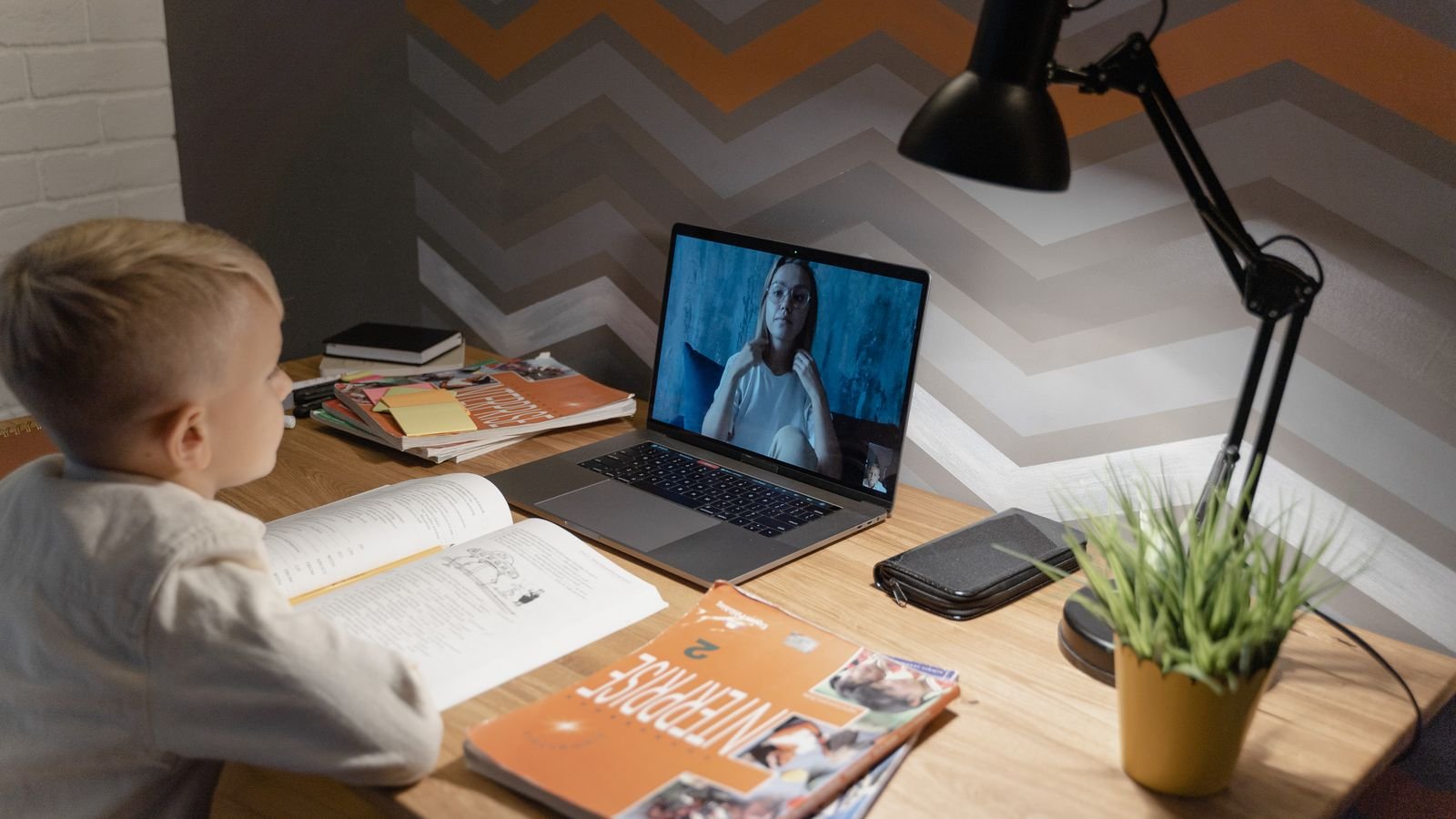
Living abroad quietly changes what a normal week looks like. School finishes at a different hour, the working day runs late, grandparents call at odd times, and the best teacher for your child’s subject may be sitting in a country several hours behind you. None of that is a problem. It is a scheduling question, and scheduling questions have answers.
This guide is for families in Singapore, Dubai, Australia, the United States and everywhere else who want a live class to become a fixed, unremarkable part of the week rather than something that gets moved twice a month and eventually dropped.
Pick the class time by working backwards from bedtime, not forwards from whatever the tutor offers. The American Academy of Sleep Medicine, in guidance endorsed by the American Academy of Pediatrics, recommends 9 to 12 hours of sleep for children aged 6 to 12 and 8 to 10 hours for teenagers. Work out your child’s real bedtime from that, then treat the hour before it as unavailable.
This single rule removes most of the bad options immediately. A 9pm class in Singapore for an eight year old looks convenient on a calendar and is a poor idea in practice. Children learn badly when tired, and worse, they start associating the subject with feeling tired. A class that is slightly less convenient for the parent but lands when the child is alert will outperform the reverse every time.
The second thing to protect is the wind-down. If the class ends at 8pm and bedtime is 8:30pm, a child who has just been thinking hard will not fall asleep on schedule. Leave a gap.
In practice, almost every expat family ends up in one of four slots, and each suits a different kind of household. It is worth choosing deliberately rather than defaulting to the first one offered.
Before school. A 7am or 7:30am class works surprisingly well for focused subjects like chess and maths, because the child is rested and nothing has gone wrong yet in their day. It only works if mornings in your home are already calm. If they are not, this slot will make them worse.
Straight after school. The most common choice, and the trap is obvious once named: a child who walks in the door and sits down immediately has had no decompression. Give at least 45 minutes for a snack and a change of clothes. After that, this slot is excellent because the child is still in learning mode.
Early evening. Around 6pm to 7:30pm suits older children and families where both parents work. It also lets a parent be present for the first few classes, which matters more than most providers admit. Watch the wind-down gap.
Weekend morning. The most underrated option. Saturday or Sunday morning is unhurried, nobody is tired, and it is far less likely to be cancelled by a school event. Families who want two sessions a week often pair one weekday slot with one weekend morning.
Six time zone facts worth knowing before you book
India runs at UTC+5:30 and Nepal at UTC+5:45. If you assume whole hours when converting, you will be late.
Singapore, the UAE and India do not observe daylight saving. The gap to Europe, the UK and much of the US therefore shifts twice a year without anything changing at your end.
Australia spans several, and only some states observe daylight saving. A class time that suits Sydney may not suit Brisbane or Perth.
Children aged 6 to 12 need 9 to 12 hours of sleep a night. That, not the calendar, is what rules out a late slot.
More than a century of research shows the same total study time produces better retention when it is spread across sessions.
Singapore sits at UTC+8 despite being close to the equator, which is why the sun there sets unusually late for its longitude.
For a live 1 on 1 class, the tutor’s local time is the provider’s problem, not yours. What matters to your child is whether the slot is stable, whether the same tutor teaches it every week, and whether the connection holds. A good provider staffs its tutors around the markets it serves, so a family in Singapore or Dubai should be offered evening slots that are perfectly ordinary working hours for the teacher.
There is one thing worth asking directly: is this tutor teaching my slot as part of their normal day, or are they staying up for it? A tutor teaching at 2am in their own country will be tired within a month, and the class quality will drift. You are entitled to ask, and a straight answer tells you a lot about how the provider is run.
The other genuine advantage of a distant tutor is availability. A family in Dubai looking for a specialist coach in a narrow subject has a far larger pool to choose from once geography is removed. That is the whole point of learning online, and it is worth taking advantage of rather than settling for whoever is nearby.
Two 30 to 45 minute sessions a week will usually teach a child more than one 90 minute session, even though the total time is identical. This is one of the most reliable findings in learning research. Distributed practice, where study is spread across sessions rather than massed into one block, produces stronger long-term retention. A meta-analytic review of classroom studies found the same pattern in real teaching settings rather than only in laboratories.
For expat families this is genuinely good news, because two short slots are far easier to fit around a school week than one long one. It also lowers the stakes of a missed week. If a family is away and one session is skipped, the rhythm survives. Miss the only session of the week and the gap becomes a fortnight.
The practical rule for younger children is to keep any single class at or under 45 minutes. Attention, not content, is the limiting factor at that age.
If you or your tutor is in a country that changes its clocks, your class time will silently move twice a year unless someone catches it. This is the single most common cause of a missed class in cross-border tutoring, and it always happens on the first Sunday after the change.
The awkward part is that most expat markets sit on the fixed side of the equation. Singapore, the UAE and India do not adjust their clocks, so from your side nothing appears to change. The gap to Europe, the UK, North America and parts of Australia moves instead. If your tutor is in one of those places, the class that was at 6pm is now at 5pm or 7pm.
Two habits solve it permanently. Put a reminder in your phone for the last week of March and the last week of October to reconfirm the slot. And insist that the class is booked as a calendar invite rather than a message, because a calendar entry with a correct time zone attached updates itself while a WhatsApp message saying “6pm on Tuesdays” does not.
Get five things in writing before you pay for anything. First, the class time stated in your local time zone, not just the tutor’s. Second, whether the same tutor teaches every session or whether tutors rotate. Third, the make-up policy for a class missed by your side and by theirs, which are often different. Fourth, how much notice you need to give to reschedule. Fifth, what happens during your school holidays: pause, continue, or bank the sessions.
A provider that answers all five quickly and in plain language is telling you it has run this situation before. A provider that gets vague about make-up classes is telling you something too.
Expat families travel more than most, and the annual trip home is where a good routine usually dies. Decide in advance rather than improvising from an airport. There are three sensible options and no wrong answer.
Pause completely for anything longer than two weeks, and tell the provider before you leave so the slot is held. Shift the time temporarily if you are visiting a country in a different zone and your child is happy to continue, which is often easy since your tutor may now be closer to you rather than further away. Or drop to one session a week for the duration, which keeps the habit alive with almost no effort.
One thing to avoid: quietly missing three classes and then feeling too awkward to restart. Providers expect holidays. Say so in advance and the slot will still be yours when you land.

Simple things you can set up at home this week
Write the time in both zones. Put it on the fridge as “6:00pm here, 3:30pm for Miss A”. Children find this genuinely interesting and it prevents a lot of confusion.
Book it as a calendar invite. A calendar entry carries its time zone with it. A chat message does not, and that difference costs families a class twice a year.
Do a dry run at the real hour. Test the laptop, the light and the noise level at the exact time the class will happen, not on a quiet Sunday afternoon.
Protect the fifteen minutes before. Snack finished, water on the desk, siblings briefed. A rushed start costs the first third of the lesson.
Set two alarms. One thirty minutes before and one five minutes before. The second one is the one that actually works.
Pick a slot that survives the holidays. If a time only works during term, you will be rescheduling every school break. Weekend mornings survive almost everything.
Diarise the clock changes. Late March and late October. Two reminders a year, and you will never lose a class to daylight saving again.
Try this one with your child. Good practice for anyone with family abroad.
A tutor in India begins a class at 5:30pm India time. Your family is in Singapore. Your cousins are in Dubai and want to watch. What time does the class start for each of you?
Tap a question to reveal the answer
The families who make online classes stick across time zones are not the ones with the most flexible schedules. They are the ones who chose a slot carefully once, wrote it down in both time zones, and then stopped negotiating with it. Everything else, the clock changes, the school holidays, the trip home, is handled by deciding in advance rather than improvising.
If you are still working out what would fit, a free trial class is the cheapest way to test a time slot rather than guess at it. Try the hour you think will work, watch how your child is at the end of it, and adjust from there.
More for curious parents
MasterMindz teaches children worldwide through live, personal 1 on 1 online classes in chess, maths, coding, Rubik’s cube, music and languages, with experienced tutors and a fun, individual approach. MasterMindz has taught 750+ students across 11+ countries.