September 28, 2026
The Singapore maths bar model is a simple drawing method that helps children see what is known, what is missing and which operation to use in a word problem.


Understanding the work is only half the job. Here is what goes wrong between the kitchen table and the exam paper.
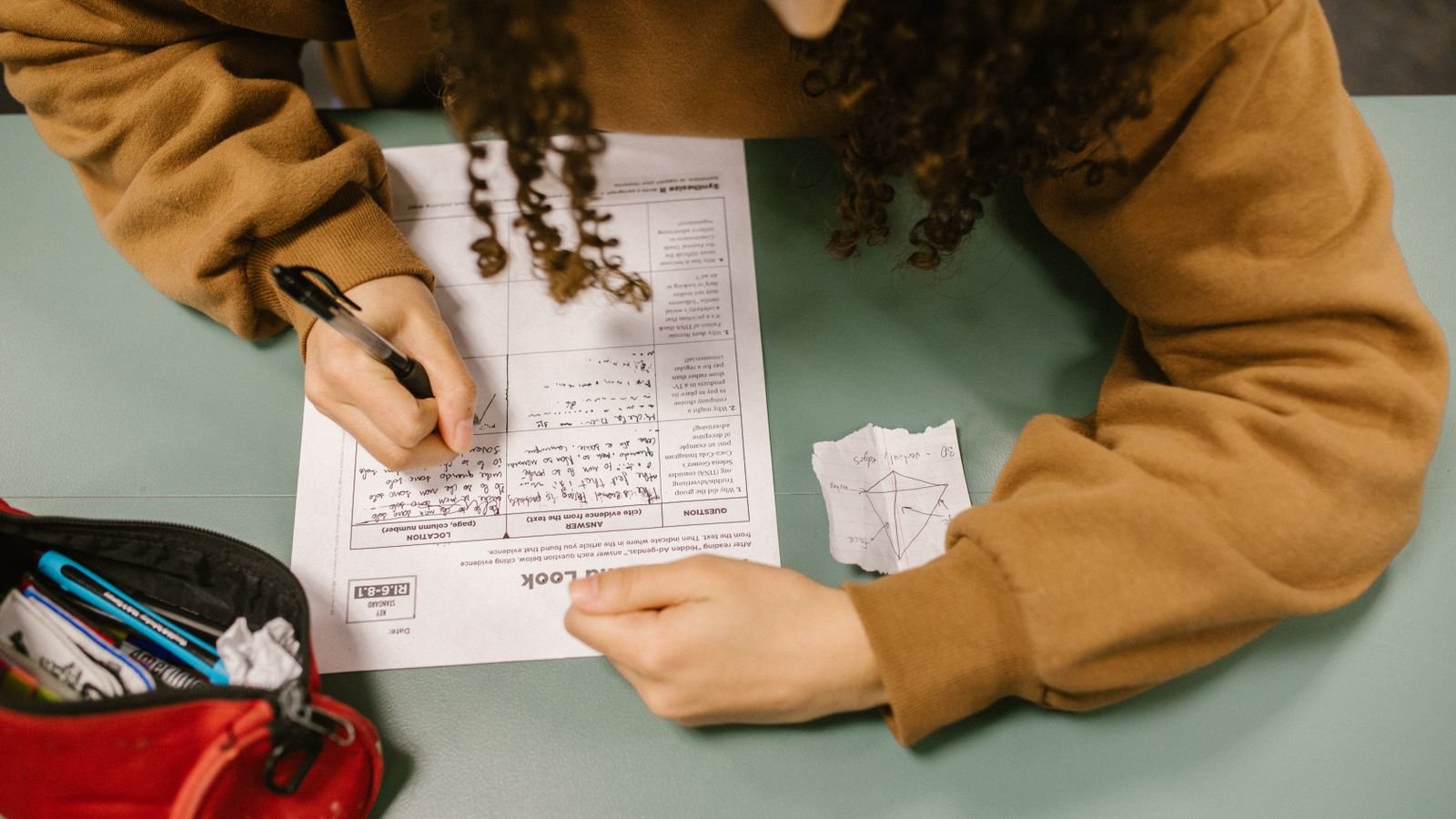
Your child can explain long division at the kitchen table on Tuesday. On Friday the test comes back with 14 out of 25, and nobody in the house, including the child, can explain what happened. If that sounds familiar, you are not imagining it, and your child is not lazy.
There is a reason this pattern is so common, and it is not the reason most parents fear. A child who understands the work but loses marks is almost never a child who cannot do maths. They are a child whose understanding is not yet reachable under exam conditions. That is a different problem, and it has a much clearer fix.
Understanding a topic and performing on a test are separate skills, and school time is mostly spent on the first one. At home, your child works with the textbook open, with you nearby, with no clock running, and with the comfort of knowing that today’s page is all about fractions. The test removes every one of those supports at once. It mixes topics without warning, it phrases questions in wording the child has not seen, it runs on a clock, and it offers no second attempt.
This is why the official curriculum treats speed and accuracy as their own goal rather than a bonus. The national curriculum for mathematics in England lists becoming fluent, meaning the ability to recall and apply knowledge rapidly and accurately, as the very first aim of the subject. Fluency is not the same as understanding. A child can have one without the other, and a test will find the gap every time.
Maths anxiety does not make a child worse at maths. It makes a child temporarily unable to reach the maths they already have. The mechanism is well documented. Working memory is the small mental workspace where a child holds a number while carrying out the next step. It has a hard limit. When a child is anxious, worried thoughts occupy that same workspace, and research on maths anxiety and working memory shows this leaves less capacity available for the calculation itself.
The effect is specific rather than general. Studies of secondary school students found that children high in maths anxiety were weaker on maths measures while performing normally in reading and writing. In other words, this is not a child who struggles with school. This is a child who struggles with one room in the school.
What it looks like at home: your child solves a question correctly when you ask casually while cooking, then freezes on the same question when it appears on a printed sheet with a heading that says Test. They go blank in the first two minutes and recover only near the end. They come out of the exam and immediately tell you the answers they could not produce twenty minutes earlier. That last one is the clearest signal of all. The knowledge was there the whole time. The pressure was standing in front of it.
Six things about maths and test performance that surprise most parents
Research puts maths anxiety at around 11 percent of school age children, and studies of adolescents report considerably higher rates again.
Working memory holds only a few items at a time. Anxious thoughts occupy the same limited space the sums need to use.
England’s national curriculum names fluency, meaning rapid and accurate recall, as the first aim of school mathematics, ahead of reasoning and problem solving.
In word problems a child can lose the mark before doing any maths at all, simply by reading the question the wrong way.
Number facts move from being worked out to being remembered through short, regular, spaced practice. Long weekend sessions do far less.
Children high in maths anxiety often score normally in reading and writing. This is not a general ability problem, which is why it responds so well to targeted help.
Knowing how to do something is not the same as being able to do it quickly enough for it to be useful. Picture a child who takes four seconds to retrieve 7 times 8. On its own, four seconds costs nothing. But inside a long multiplication question, that retrieval happens six or seven times, and each time it happens the child has to put down the thing they were holding in their head in order to go and fetch it. By the third line of working, the original plan has slipped away and the answer is wrong for reasons that have nothing to do with long multiplication.
This is the single most common cause of the pattern in the title, and it is the most invisible one. At home, with no clock, your child gets there. The four seconds do not show. In a forty minute paper with twenty five questions, those four seconds multiply into something that eats the whole exam.
The tell is timing rather than accuracy. Ask your child to do twenty single-step number facts and time it quietly. If the answers are right but the pace is slow and uneven, fluency is your problem, and no amount of re-teaching the topic will fix it. Short daily recall practice will.
Careless mistakes almost always come from a missing routine rather than from carelessness. The child who copies 47 from the question and writes 74 in their working is not being sloppy. They have simply never been taught a habit that catches it. The same is true of the child who does every step of a multi-step problem correctly and then writes down the answer to step two instead of step four, or who solves for the number of boxes and forgets that the question asked for the number of pencils.
Telling a child to be more careful does nothing, because “careful” is not an instruction anybody can follow. A routine is. Underline what the question is actually asking before starting. Write the unit next to the answer every time. Check by working backwards rather than by re-reading forwards, because re-reading forwards makes a child repeat the same wrong assumption. These are small, teachable, mechanical habits, and they typically recover more marks in a term than any amount of extra topic revision.
A large part of any modern maths paper is a reading test wearing a maths costume. Word problems ask a child to convert ordinary sentences into an operation, and the conversion is where the mark is won or lost. “How many more does Ravi have than Mei” is a subtraction. “How many do they have altogether” is an addition. “Three for two dollars, how much for twelve” is a division followed by a multiplication, and a child who jumps straight to multiplication will produce a confident, neat, entirely wrong answer.
This cause hits two groups particularly hard. The first is children who are strong at calculation and therefore rush into the numbers without reading properly, because the numbers are the part they enjoy. The second is children working in a language that is not spoken at home, where an unfamiliar context word can derail an otherwise easy question. In both cases the maths is intact. The translation step is not.
You can diagnose this yourself in about twenty minutes, and it is worth doing before you buy anything or hire anyone. Get the last marked paper, not the grade, and go through every single lost mark with your child, sorting each one into one of four piles.
Pile one, blank or abandoned. Questions started and given up on, or left empty despite being on a topic they know. This is usually anxiety, especially if the blanks cluster at the start of the paper.
Pile two, right method, wrong arithmetic. The approach is correct and the working breaks down inside a number fact or a carry. This is fluency.
Pile three, right maths, wrong answer written down. Correct working, then a copying slip, a missing unit, or the answer to an earlier step. This is process.
Pile four, wrong operation from the start. Clean, confident working on the wrong question. This is decoding.
Almost every child produces one clearly dominant pile. That pile is where your effort should go, and it is very often not the pile you assumed before you started sorting.
This problem is diagnostic rather than instructional, which is exactly what one to one teaching is good at and group teaching is not. A class teacher sees the finished page. They cannot see that your child paused for six seconds before every multiplication, or that the panic arrived at question three and never left, or that the child read the word “remaining” and quietly guessed. Those things are only visible while the child is working, in real time, with someone watching.
In a live 1 on 1 class the tutor can stop at the exact moment of hesitation and ask what just happened. That single question, asked at the right second, often uncovers in one session what six months of homework never surfaced. It is also the reason a child who has been quietly avoiding maths can rebuild confidence quickly here. Nobody else in the room is watching them get it wrong.
Seven things you can start this week, none of which need extra worksheets
Ask how, never whether. Replace “is that right?” with “how did you get that?”. You will hear the exact step where it wobbles, and your child stops treating you as a marker.
Two minutes a day beats an hour on Sunday. Number facts stick through short, frequent recall. Two minutes before breakfast, five days a week, will do more for exam speed than a long weekend session.
Run one timed page a week. Not to add pressure, but to make pressure ordinary. If the only timed maths your child ever does is the real test, the test will always feel like an event.
Teach the underline rule. Before writing anything, underline what the question is asking for. Pencils, not boxes. Total, not difference. This one habit removes most decoding errors.
Check backwards, not forwards. Re-reading your own working forwards just repeats the same assumption. Putting the answer back into the question catches the mistake instead.
Never say you were bad at maths too. It is meant kindly and it lands as permission to give up. Try “this bit is hard, let us work out which bit” instead.
The night before, protect sleep not syllabus. Late cramming costs more in working memory the next morning than it adds in content. Stop early, go to bed, eat breakfast.
Read it with your child. This is exactly the kind of error that costs confident children marks.
A shop sells pencils at 3 for $2. How much do 12 pencils cost?
A child writes: 12 x 2 = 24, so the answer is $24. The multiplication is perfect. The answer is wrong. Why?
Tap a question to reveal the answer
Start with the marked paper, not with a plan. Sort the lost marks into the four piles, find the dominant one, and choose the matching fix rather than doing all four at once. If the pile is anxiety, take the pressure off and rebuild small wins. If it is fluency, two minutes a day. If it is process, teach the two habits. If it is decoding, read questions aloud together and translate them into operations before touching a number.
And if you cannot tell which pile it is, that in itself is a good reason to have someone sit with your child and watch them work. A single hour of live one to one attention will usually tell you more than a term of guessing, and it costs you nothing to find out.
More for curious parents
MasterMindz offers live 1 on 1 online classes for children and has taught 750+ students across 11+ countries. We teach chess, maths, coding and more through personal, one to one lessons with experienced tutors, so a child is never one of thirty. Parents often ask where their child can get maths help online when the problem is confidence rather than ability. That is exactly what a MasterMindz 1 on 1 maths class is built for, and the first trial class is free.